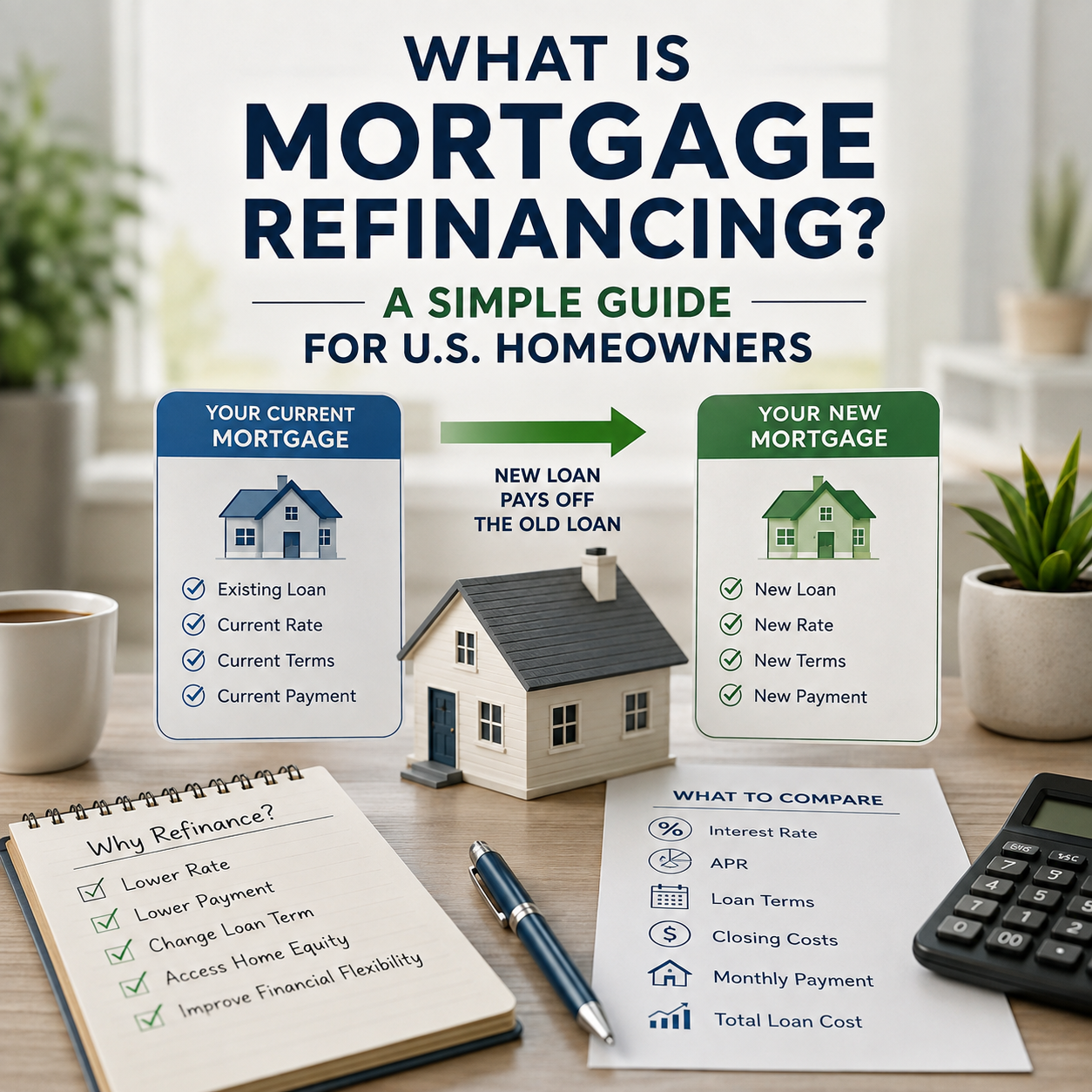
Mortgage refinancing is the process of replacing an existing mortgage with a new home loan. The replacement mortgage generally pays off the old loan, and the homeowner then repays the new mortgage under a different set of terms.
That definition is simple, but the decision is not. Refinancing can change the interest rate, APR, loan term, monthly payment, closing costs, escrow arrangement, home equity, loan balance, and total repayment path. Homeowners asking what is mortgage refinancing should therefore look beyond one attractive rate or payment and examine the complete replacement loan.
Educational note: USRefiRates.com provides general mortgage refinancing education only and does not provide financial, legal, tax, accounting, or lending advice. We are not a lender, broker, loan marketplace, credit provider, or approval service. Mortgage rates, APRs, fees, closing costs, underwriting requirements, property valuations, loan terms, rate-lock conditions, and available refinance options vary by lender, borrower, property, loan program, documentation, and other circumstances. Homeowners should rely on the lender’s official disclosures and loan documents when evaluating a specific transaction.
What Is Mortgage Refinancing? Quick Answer
What is mortgage refinancing? In plain English, it means taking out a new mortgage that replaces the mortgage currently secured by the home.
The replacement loan may have a different:
- Interest rate
- APR
- Loan amount
- Loan term
- Monthly payment
- Fixed or adjustable rate structure
- Closing-cost structure
- Escrow arrangement
- Mortgage-insurance treatment
- Home-equity impact
- Scheduled payoff date
Refinancing is a new mortgage transaction. It is not merely a small edit to the old loan.
The homeowner should compare the proposed mortgage with the mortgage being replaced and determine whether the change supports a clear objective after the costs, risks, and repayment obligations are understood.
How Mortgage Refinancing Works
A homeowner considering what is mortgage refinancing usually begins by reviewing the existing mortgage.
Important information can include:
- Current principal balance
- Interest rate
- Remaining loan term
- Principal-and-interest payment
- Fixed or adjustable structure
- Escrow arrangement
- Mortgage insurance, if applicable
- Approximate payoff amount
- Important loan features or restrictions
The homeowner can then approach lenders and request refinance options. A lender may review borrower and property information such as income, assets, credit, existing debts, occupancy, property value, home equity, insurance, loan purpose, and the requested loan structure.
If the application is approved and the refinance closes, the proceeds from the replacement mortgage generally pay off the existing mortgage. The homeowner then begins making payments under the new loan terms.
For a deeper process explanation, review how does refinancing a mortgage work.
The central point is that refinancing creates a new obligation. A lower rate or payment can be useful, but the homeowner needs to understand what changes in exchange for that benefit.
Why Homeowners Consider Refinancing
There is no single reason homeowners refinance.
A homeowner may want to:
- Change from an adjustable-rate mortgage to a fixed-rate mortgage
- Change the repayment term
- Reduce monthly payment pressure
- Obtain a different interest rate
- Change the overall cost structure of the mortgage
- Access home equity through a cash-out refinance
- Remove or change a loan feature
- Replace a mortgage that no longer fits the household plan
Understanding what is mortgage refinancing starts with identifying the objective.
A refinance that helps one homeowner may be unsuitable for another because their existing mortgages, budgets, home-equity positions, expected time in the property, and financial priorities are different.
The goal should therefore be defined before lender offers arrive. Otherwise, the decision can easily become focused on whichever advertised number looks most appealing.
Start With the Existing Mortgage
One of the strongest ways to understand what is mortgage refinancing is to begin with the loan already in place.
Write down:
- Remaining mortgage balance
- Interest rate
- Remaining repayment term
- Monthly principal-and-interest payment
- Fixed or adjustable rate structure
- Escrow arrangement
- Mortgage insurance, if applicable
- Approximate payoff amount
- Any valuable features of the existing mortgage
Then compare the proposed refinance.
Review:
- New loan amount
- Interest rate
- APR
- New loan term
- Estimated payment
- Discount points
- Lender credits
- Lender fees
- Third-party closing costs
- Cash needed to close
- Costs financed into the new loan
- Rate-lock status
- Fixed or adjustable structure
The proper comparison is not simply Lender A versus Lender B.
It is:
Existing mortgage versus proposed replacement mortgage.
That baseline can prevent a homeowner from accepting a lower payment that is mainly the result of restarting the debt over a much longer term, increasing the balance, or financing substantial costs.
What Refinancing Can Change
A refinance can alter several parts of the homeowner’s mortgage at the same time.
It may change the:
- Interest rate
- Monthly principal-and-interest payment
- Repayment term
- Loan balance
- Rate type
- Payoff date
- Closing costs
- Escrow arrangement
- Home-equity position
- Mortgage insurance
- Total amount repaid over time
This is why homeowners asking what is mortgage refinancing should not treat it as a one-number question.
A homeowner might obtain a lower rate but increase the mortgage balance. Another might shorten the term and accept a higher monthly payment. Another may improve payment predictability by moving from an adjustable rate to a fixed rate.
The strongest refinance is not necessarily the one that produces the lowest figure in one category. It is the one whose complete structure fits the objective the homeowner is trying to achieve.
Mortgage Refinance Rates and APR
The interest rate is one of the first numbers homeowners notice, but it should not be reviewed by itself.
The interest rate affects the cost of borrowing and helps determine the principal-and-interest payment.
APR provides a broader annualized measure because certain costs associated with obtaining the mortgage are reflected in it.
Homeowners comparing mortgage refinance rates should look at both the interest rate and APR, along with points, lender credits, closing costs, loan term, loan balance, and cash needed to close.
Two offers can show similar rates while having different APRs and upfront costs. Two other offers may have different interest rates because one requires discount points and the other does not.
The useful question is not merely “Which rate is lower?”
It is:
What does this rate cost to obtain, and how does the complete loan compare with the mortgage I already have?
Discount Points
Discount points generally involve paying more upfront in exchange for a lower interest rate.
When learning what is mortgage refinancing, homeowners should understand that a lower quoted rate may be connected to a point charge.
A useful comparison considers:
- Cost of the points
- Resulting interest-rate difference
- Monthly payment difference
- Cash available at closing
- Expected time in the mortgage
- Estimated break-even period
- Total borrowing cost
Points are not automatically good or bad.
Someone who expects to keep the replacement mortgage for many years may evaluate points differently from someone who expects to sell or refinance again relatively soon.
The correct comparison uses the actual written loan terms rather than assuming that the lowest headline rate is automatically the cheapest option.
Lender Credits
Lender credits can work in the opposite direction.
A lender may provide a credit that offsets some upfront closing costs in exchange for different loan pricing, commonly including a higher interest rate.
This can reduce the cash required at closing, but it does not mean the refinance has become free.
Compare:
- Interest rate
- APR
- Amount of the lender credit
- Remaining closing costs
- Cash to close
- Monthly payment
- Expected time in the mortgage
- Total borrowing cost
Homeowners asking what is mortgage refinancing should treat points and lender credits as pricing trade-offs rather than simple discounts.
Refinance Closing Costs
Refinancing generally involves costs in addition to interest.
Depending on the loan, these may include:
- Origination or other lender charges
- Appraisal-related costs
- Title services
- Settlement services
- Recording charges
- Prepaid interest
- Escrow funding
- Other third-party or closing expenses
For a detailed explanation of these categories, review refinance closing costs.
A lower payment does not automatically mean the refinance costs less.
Some expenses may be paid upfront. Eligible costs may sometimes be financed into the replacement mortgage. Lender credits can also reduce some upfront charges.
The way costs are handled can affect the amount of cash needed at closing, the new mortgage balance, the interest rate, and the overall cost of borrowing.
Closing Costs vs Cash to Close
Closing costs and cash to close are connected, but they are not the same thing.
Closing costs refer to the charges and expenses associated with completing the mortgage transaction.
Cash to close is the amount the homeowner is expected to provide at closing after applicable credits, prepaid items, escrow funding, financed costs, and other transaction adjustments are taken into account.
Two refinance offers can have similar closing costs while requiring different amounts of cash at closing.
One may use lender credits. Another may finance eligible costs. Another may require more of the expenses to be paid upfront.
When considering what is mortgage refinancing, the homeowner should understand what creates the cash-to-close figure instead of assuming that the smallest upfront amount automatically means the lowest-cost loan.
Paying Costs Upfront vs Financing Them
Paying refinance costs upfront can keep the new mortgage balance lower, but it requires more cash at closing.
Financing eligible costs can reduce immediate cash pressure while increasing the amount borrowed.
A homeowner should compare:
- Cash needed at closing
- New mortgage balance
- Interest rate
- APR
- Monthly payment
- Loan term
- Expected time in the mortgage
- Total borrowing cost
A cost does not disappear simply because it is added to the loan.
If financed, it becomes part of the debt being repaid.
What a “No-Closing-Cost” Refinance Can Mean
Homeowners may encounter refinance offers described as “no-closing-cost” loans.
That label should be examined carefully.
Some structures may use lender credits to offset certain upfront expenses in exchange for different loan pricing. Eligible costs may also be incorporated into the new mortgage balance in some transactions.
The useful questions are:
- What am I paying upfront?
- What rate am I receiving?
- Is the loan balance increasing?
- Are lender credits involved?
- What happens to the monthly payment?
- What will the mortgage cost over the period I expect to keep it?
This is another reason what is mortgage refinancing should be answered as a full-loan question rather than a headline-rate question.
Main Types of Mortgage Refinancing
For homeowners asking what is mortgage refinancing, understanding the main refinance structures makes the topic much easier to navigate.
Rate-and-Term Refinance
A rate-and-term refinance generally replaces the existing mortgage to change the interest rate, loan term, loan type, or repayment structure without primarily using the transaction to withdraw additional home equity as cash.
A homeowner might consider this structure to move from an adjustable rate to a fixed rate, shorten or extend the repayment term, or change another feature of the mortgage.
Cash-Out Refinance
A cash out refinance replaces the existing mortgage with a larger new mortgage and may allow the homeowner to receive part of the available equity as cash, subject to lender requirements.
Because the mortgage balance increases, review:
- Cash received
- New mortgage balance
- Remaining equity
- Interest rate
- APR
- Closing costs
- Loan term
- Monthly payment
- Repayment risk
Cash-out refinancing serves a different purpose from a straightforward rate-and-term refinance, so the two should not be compared as though they are identical transactions.
For a deeper decision framework, see cash out refinance pros and cons.
Fixed-Rate Refinance
A fixed-rate mortgage keeps its stated interest rate unchanged for the loan term.
This can provide greater predictability for principal-and-interest payments.
Adjustable-Rate Refinance
An adjustable-rate mortgage can change according to the loan agreement after any applicable initial period.
Homeowners should understand the adjustment schedule, index, margin, adjustment caps, and possible future payment changes before choosing this structure.
Mortgage Refinancing and Home Equity
Home equity is the difference between the value of the property and the mortgage debt secured against it.
What is mortgage refinancing can have different implications for equity depending on the transaction.
A rate-and-term refinance may replace the existing mortgage without substantially increasing the balance to provide cash to the homeowner.
A cash-out refinance increases the mortgage balance when additional equity is borrowed.
That matters because home equity is not cash sitting in a savings account. Accessing equity through refinancing means turning part of that equity into debt secured by the property.
A homeowner considering cash out should compare the purpose of the funds with:
- New loan balance
- Remaining equity
- Monthly payment
- Closing costs
- Loan term
- Interest cost
- Repayment risk
The amount received at closing is only one part of the transaction.
Cash-Out Refinance vs Other Equity Options
A homeowner who wants access to equity may have alternatives to replacing the entire first mortgage.
Possible structures can include a home equity loan or home equity line of credit.
Whether one structure is preferable depends on the homeowner’s objective and the actual terms available.
For example, someone who values the existing first mortgage may evaluate a separate home-equity product differently from someone who already wants to replace the first mortgage.
This is why what is mortgage refinancing should include the question:
Do I actually need to replace my existing mortgage to achieve the goal?
That question becomes especially important when the refinance is primarily being considered to obtain cash.
Shorter Loan Term vs Longer Loan Term
The repayment term can materially change the appearance of a refinance.
A shorter term may create a faster payoff path but can require a higher monthly payment.
A longer term may reduce the monthly payment but extend the period in which the homeowner remains in debt.
A homeowner asking what is mortgage refinancing should therefore compare the proposed new term with the years remaining on the existing mortgage.
For example, replacing a mortgage that already has many years of repayment completed with a new long-term loan may reduce the monthly payment while substantially extending the scheduled payoff date.
That can still fit a particular cash-flow objective.
The key is that the longer debt timeline should be a deliberate choice rather than an overlooked consequence.
Monthly Payment vs Total Borrowing Cost
Monthly payment matters because the mortgage needs to fit the household budget.
However, a lower payment can result from several different changes:
- Lower interest rate
- Longer loan term
- Different mortgage balance
- Different loan structure
- Financed closing costs
- Changes in escrow or mortgage insurance
This is why understanding what is mortgage refinancing requires more than asking whether the payment goes down.
The stronger question is:
What creates the payment change, and what will the replacement mortgage cost over the period I expect to keep it?
A refinance can improve monthly cash flow while extending debt for many additional years.
That outcome may support the homeowner’s objective, but it should be understood before the loan is accepted.
Fixed vs Adjustable Rate Risk
A fixed-rate refinance and an adjustable-rate refinance may show different initial pricing, but they also create different future-payment possibilities.
With a fixed rate, the stated interest rate remains unchanged for the loan term.
With an adjustable rate, the rate can change according to the loan agreement.
When evaluating an adjustable-rate refinance, review:
- Initial rate period
- Adjustment frequency
- Index
- Margin
- Periodic caps
- Lifetime caps
- Potential future payment changes
A lower starting rate does not automatically make the adjustable option the better refinance.
For anyone researching what is mortgage refinancing, the decision depends on the terms of the loan and the homeowner’s objectives.
How Lenders May Evaluate a Refinance Application
A refinance is a new mortgage application.
The lender may therefore evaluate both the borrower and the property.
Factors can include:
- Credit history
- Credit score
- Income
- Employment or income stability
- Assets
- Existing debts
- Debt-to-income relationship
- Mortgage payment history
- Property value
- Home equity
- Occupancy
- Loan purpose
- Requested loan amount
- Loan type
- Documentation
Requirements and pricing vary by lender and loan program.
Two homeowners applying at the same time may receive different offers, and the same homeowner may receive different terms from different lenders.
A homeowner researching what is mortgage refinancing should never treat another borrower’s rate, payment, or approval result as a reliable prediction of their own outcome.
Mortgage Refinance Quotes
Once the homeowner understands the basic refinance structure, the next step is often comparing actual lender offers.
The mortgage refinance quotes pillar explains how to compare written proposals in detail.
The useful comparison should include:
- Loan amount
- Interest rate
- APR
- Loan term
- Rate structure
- Points
- Lender credits
- Lender fees
- Third-party costs
- Cash to close
- Financed costs
- Rate-lock status
The offers should be based on similar loan structures where practical.
A quote for a cash-out refinance should not automatically be compared with a rate-and-term quote as though the transactions are identical.
Loan Estimates and Comparing Offers
A Loan Estimate provides standardized information about important mortgage terms and estimated costs.
It can include information such as:
- Loan amount
- Interest rate
- Projected principal-and-interest payment
- Whether the interest rate can increase
- Estimated taxes, insurance, and assessments
- Estimated closing costs
- Estimated cash to close
- Origination charges
- Discount points
- Lender credits
- Prepaid items
- Escrow information
- APR
- Certain loan features
For homeowners learning what is mortgage refinancing, comparing Loan Estimates can make lender differences easier to identify.
A homeowner should try to compare similar loan structures rather than focusing on isolated figures from different types of mortgages.
A shorter adjustable-rate loan and a longer fixed-rate loan can produce very different numbers because they are fundamentally different products.
Rate Locks
A quoted interest rate may not necessarily be locked.
A rate lock generally protects an agreed interest rate for a defined period if the transaction closes within the specified timeframe and there are no changes to the application that affect the terms.
The Loan Estimate states whether the rate is locked.
Homeowners should ask:
- Is the rate locked?
- When does the lock expire?
- What terms are covered?
- Are points and lender credits included?
- What happens if closing is delayed?
- Is there a cost to extend the lock?
- What application changes could affect the terms?
Understanding what is mortgage refinancing includes distinguishing between an advertised or quoted rate and a rate that has actually been locked under written lender terms.
Loan Estimate vs Closing Disclosure
For homeowners asking what is mortgage refinancing, the Loan Estimate is useful earlier in the mortgage process because it presents proposed loan terms and estimated costs.
The Closing Disclosure provides final information about the transaction as closing approaches.
Before signing, compare the Closing Disclosure with the earlier Loan Estimate.
Check whether important figures still match expectations:
- Loan amount
- Loan term
- Loan type
- Interest rate
- Monthly principal-and-interest payment
- Closing costs
- Cash to close
- Points
- Lender credits
If a material figure changed, ask the lender to explain why.
The final written documents matter more than a marketing page, verbal conversation, or preliminary estimate.
Refinance vs Loan Modification
Refinancing and loan modification are different concepts.
Refinancing generally involves obtaining a new mortgage that replaces the existing mortgage.
A loan modification changes the terms of the existing loan rather than replacing it with a new mortgage.
This distinction matters because homeowners asking what is mortgage refinancing may sometimes use the word “refinance” when they actually mean changing the current loan.
The appropriate path depends on the homeowner’s circumstances and the options available through the lender or servicer.
Refinance vs Selling the Home
Refinancing keeps the property in place while replacing the mortgage.
Selling the home is a different decision.
This distinction sounds obvious, but it matters when the homeowner is uncertain about how long the property will be kept.
A refinance with substantial upfront costs may be evaluated differently by someone expecting to stay in the property for a long period than by someone who may sell relatively soon.
Expected time in the home and expected time in the new mortgage can therefore affect how the refinance is evaluated.
Break-Even Thinking
Homeowners sometimes estimate how long it might take for an expected monthly benefit to recover the upfront cost of obtaining the replacement mortgage.
A simple starting concept is:
refinance costs ÷ expected monthly savings = approximate break-even period
This should use the homeowner’s actual written figures.
It is also only one planning tool.
A refinance can change:
- Mortgage balance
- Scheduled payoff date
- Home equity
- Loan term
- Interest rate
- Monthly payment
- Total borrowing cost
A homeowner considering what is mortgage refinancing should therefore use break-even thinking alongside the complete loan structure rather than treating the calculation as a guarantee of savings.
Break-Even Thinking for Discount Points
Discount points can also be evaluated using a simple break-even framework.
Suppose two otherwise comparable offers differ mainly because one requires points in exchange for a lower interest rate.
The homeowner can compare:
- Cost of the points
- Monthly payment difference
- Expected time in the mortgage
Dividing the point cost by the estimated monthly payment reduction can provide a rough indication of how long it might take to recover the additional upfront cost.
This does not automatically determine whether paying points is appropriate.
It simply makes the trade-off easier to understand.
Comparing Mortgage Refinance Offers Side by Side
A simple table can help organize the decision.
| Compare | Existing Mortgage | Refinance Offer A | Refinance Offer B |
|---|---|---|---|
| Loan balance | Current | Proposed | Proposed |
| Interest rate | Current | Quoted | Quoted |
| APR | Current/available | Quoted | Quoted |
| Loan term | Remaining | Proposed | Proposed |
| Rate structure | Fixed/adjustable | Fixed/adjustable | Fixed/adjustable |
| Principal-and-interest payment | Current | Estimated | Estimated |
| Points | — | Quoted | Quoted |
| Lender credits | — | Quoted | Quoted |
| Lender fees | — | Estimated | Estimated |
| Other closing costs | — | Estimated | Estimated |
| Cash to close | — | Estimated | Estimated |
| Costs financed | — | Estimated | Estimated |
| Rate locked? | — | Yes/No | Yes/No |
| Cash-out received | — | If applicable | If applicable |
The table does not choose a winner.
Its purpose is to stop one attractive number from dominating the decision.
A homeowner researching what is mortgage refinancing should judge each proposed loan against both competing offers and the existing mortgage.
Common Mortgage Refinancing Mistakes
Focusing Only on the Interest Rate
A low rate may require points or be paired with other costs.
Looking Only at the Monthly Payment
A lower payment may result from extending the loan term.
Ignoring APR
APR can provide broader context about certain costs associated with obtaining the mortgage.
Ignoring Closing Costs
Upfront and financed costs can materially affect the transaction.
Treating a Quote as Final Approval
A rate quote or preliminary estimate does not mean underwriting is complete.
Comparing Different Loan Structures
Cash-out and rate-and-term refinances can serve different purposes and create different loan balances and risks.
Using Home Equity Without a Clear Purpose
Cash received through a cash-out refinance becomes additional mortgage debt secured by the property.
Ignoring the Existing Mortgage
A refinance should always be compared with the loan it replaces.
Relying Only on Verbal Explanations
Important terms should be checked against written lender disclosures and loan documents.
Assuming “No Closing Cost” Means Free
Costs can be shifted into a higher rate, lender-credit structure, or increased loan balance.
Questions to Ask Before Refinancing
Before proceeding, a homeowner can ask:
- What is my main reason for refinancing?
- What feature of the existing mortgage am I trying to change?
- What is the new loan amount?
- How does the new term compare with the remaining term?
- What is the interest rate?
- What is the APR?
- Are discount points required?
- Are lender credits included?
- What are the estimated closing costs?
- How much cash will I need at closing?
- Are any costs being financed?
- Is the rate locked?
- What will happen to my home equity?
- What could cause the terms to change?
- How long do I expect to keep the mortgage?
- Does the refinance still make sense when compared with simply keeping the existing loan?
These questions turn what is mortgage refinancing from a definition into a practical decision framework.
Preparing Before Requesting Refinance Offers
Before contacting lenders, gather information that can make the requests more consistent.
Useful items can include:
- Existing mortgage statement
- Approximate payoff amount
- Existing interest rate
- Remaining term
- Current payment
- Property information
- Approximate property value
- Income information
- Asset information
- Existing debts
- Insurance information
- Refinance objective
- Desired loan amount
- Desired cash-out amount, if applicable
For homeowners who prefer a digital application process, online mortgage refinance explains the main online refinance steps and comparison considerations.
Consistent information makes lender offers easier to compare.
For unfamiliar terminology, the mortgage refinance glossary provides plain-English explanations of common refinance terms used throughout lender disclosures and comparison documents.
Four Simple Homeowner Examples
Example 1: Moving to a Fixed Rate
A homeowner with an adjustable-rate mortgage wants more predictable principal-and-interest payments.
The homeowner compares fixed-rate refinance offers and reviews the rate, APR, closing costs, loan term, and new monthly payment.
For this homeowner, what is mortgage refinancing is primarily a question about changing payment and rate risk.
Example 2: Choosing a Shorter Term
Another homeowner wants to repay the mortgage sooner.
A shorter-term refinance may carry a different interest rate and a higher monthly payment.
The homeowner compares the faster payoff path with the effect on the monthly budget.
Example 3: Lower Payment but Longer Term
A homeowner receives a refinance offer with a lower monthly payment.
The replacement loan, however, substantially extends the repayment schedule.
The homeowner compares the immediate cash-flow benefit with the longer debt timeline, closing costs, and overall borrowing cost.
Example 4: Accessing Home Equity
A homeowner considers a cash-out refinance for a major planned expense.
The homeowner reviews the cash received, new loan balance, remaining equity, closing costs, monthly payment, loan term, and repayment risk.
The cash received is only one component of the transaction.
When Refinancing Deserves Extra Caution
For homeowners asking what is mortgage refinancing, a proposed refinance deserves closer review when the apparent benefit depends heavily on:
- A much longer repayment term
- Significant discount points
- Large financed costs
- A substantially higher loan balance
- Reduced home equity
- Adjustable future payments
- Unclear lender credits
- A short or unclear rate-lock period
- Assumptions the homeowner does not understand
Additional caution is appropriate when the homeowner feels pressured to proceed before understanding the written documents.
A refinance is a major secured-debt transaction.
The loan should still make sense after the initial excitement of a lower rate or payment has been replaced by a careful review of the complete terms.
Practical Next Steps
Start with the mortgage already in place.
Write down the balance, interest rate, payment, remaining term, and the reason refinancing is being considered.
Then request reasonably comparable written offers when appropriate.
Review:
- Interest rate
- APR
- Points
- Lender credits
- Closing costs
- Loan term
- Cash to close
- Financed costs
- Rate-lock status
- New loan balance
- Expected time in the mortgage
Use Loan Estimates to make lender comparisons more consistent.
Before closing, review the Closing Disclosure and ask the lender about important terms or differences that are unclear.
What is mortgage refinancing ultimately comes down to whether the replacement mortgage intentionally improves or changes the homeowner’s position after its costs, risks, and repayment obligations are understood.
FAQs About What Is Mortgage Refinancing
What Is Mortgage Refinancing in Simple Terms?
What is mortgage refinancing? It means replacing an existing mortgage with a new mortgage. The replacement loan generally pays off the old mortgage, and the homeowner then repays the new loan under its own terms.
Why Do Homeowners Refinance Mortgages?
Homeowners may refinance to change the interest rate, loan term, rate structure, monthly payment, or another mortgage feature. Some homeowners also refinance to access home equity.
Does Refinancing Always Lower the Monthly Payment?
No. The payment depends on the loan balance, interest rate, repayment term, loan structure, financed costs, and other factors. A shorter-term refinance can have a higher monthly payment even when the interest rate is lower.
Does Refinancing Always Save Money?
No. Closing costs, points, lender fees, loan term, financed costs, and the homeowner’s expected time in the mortgage can affect the financial result.
What Is Mortgage Refinancing With Cash Out?
What is mortgage refinancing with cash out? It is a refinance in which the existing mortgage is replaced with a larger new mortgage and the homeowner may receive part of the available equity as cash, subject to lender requirements.
Is Refinancing the Same as a Loan Modification?
No. Refinancing generally replaces the existing mortgage with a new mortgage. A loan modification changes the terms of the existing loan.
Should Homeowners Compare More Than One Lender?
Comparing multiple reasonably similar written offers can reveal differences in rates, APR, points, lender credits, fees, terms, and assumptions.
What Documents Matter When Refinancing?
The Loan Estimate helps borrowers review proposed loan terms and estimated costs. The Closing Disclosure provides final transaction information before closing.
What Should Homeowners Compare Before Refinancing?
Compare the existing mortgage with the proposed loan amount, rate, APR, term, payment, points, lender credits, closing costs, cash to close, financed costs, rate-lock status, equity impact, and expected time in the new loan.
Can a Refinance Rate Change Before Closing?
Yes. An unlocked rate can change. Even a locked rate can be affected in certain circumstances when application details change or the lock period expires.
Does Refinancing Reset the Mortgage Term?
A refinance creates a new loan term. Whether that term is shorter, similar, or longer than the remaining term on the existing mortgage depends on the replacement loan selected.
Is Mortgage Refinancing Always the Best Way to Access Equity?
No. Homeowners may have other home-equity borrowing options. Whether replacing the first mortgage makes sense depends on the objective and the actual terms available.
Final Takeaway
What is mortgage refinancing? At its core, it is the process of replacing an existing mortgage with a new mortgage secured by the home.
A refinance can change the interest rate, APR, repayment term, monthly payment, loan balance, closing costs, rate structure, equity position, and scheduled payoff path.
The strongest decision does not come from chasing one attractive rate or payment.
It comes from comparing the replacement mortgage with the existing loan and understanding:
- What changes
- What the refinance costs
- What happens to the loan balance
- What happens to home equity
- How long the new mortgage lasts
- What repayment obligation is being accepted
Understanding what is mortgage refinancing means understanding the complete replacement loan before signing, not merely the headline rate used to advertise it.
Helpful Resources
- CFPB Mortgage Resources
- CFPB Loan Estimate Guide
- CFPB Closing Disclosure Guidance
- CFPB Rate Lock Guidance
- FTC Credit, Loans and Debt Guidance
- Freddie Mac Homeowner Education
Author Bio
USRefiRates Editorial Team creates practical U.S. mortgage refinance education designed to help homeowners understand loan terms, rates, closing costs, home equity, lender comparisons, and mortgage documents before making borrowing decisions.
Copyright Notice
© 2026 – USRefiRates. All rights reserved.
This article about what is mortgage refinancing is original educational content published by USRefiRates and may not be copied, scraped, spun, republished, redistributed, or used commercially without prior written permission. Brief quotations may be used with clear attribution and a link to the original page.
USRefiRates.com publishes mortgage refinance, home loan, cash-out refinance, rate-and-term refinance, home-equity, closing-cost, lender-comparison, and related mortgage education for informational purposes. Unauthorized bulk reuse, automated scraping, AI rewriting, content spinning, or republication of this material is prohibited.
Educational Disclaimer
This what is mortgage refinancing guide is provided for general educational and informational purposes only. It is not financial, legal, tax, accounting, lending, real-estate, or mortgage advice.
USRefiRates.com is not a lender, mortgage broker, loan marketplace, credit provider, or approval service. Mortgage rates, APRs, points, lender credits, fees, closing costs, loan terms, underwriting requirements, property valuations, rate-lock conditions, eligibility standards, and available refinance options vary according to lender, borrower, property, loan program, documentation, and other circumstances.
Homeowners should rely on the lender’s official Loan Estimate, Closing Disclosure, loan agreement, rate-lock documents, and other applicable disclosures when evaluating a specific refinance transaction. Qualified professional guidance should be obtained when appropriate.
Thanks for your comment. When comparing mortgage refinance options, it is usually safest to look at the rate, APR, closing costs, cash-to-close, loan term, lender requirements, and whether the refinance fits the homeowner’s goal. USRefiRates shares general educational information only, not personal financial advice.
Thanks for your comment. When comparing mortgage refinance options, it is usually safest to look at the rate, APR, closing costs, cash-to-close, loan term, lender requirements, and whether the refinance fits the homeowner’s goal. USRefiRates shares general educational information only, not personal financial advice.
Thanks for your comment. When comparing mortgage refinance options, it is usually safest to look at the rate, APR, closing costs, cash-to-close, loan term, lender requirements, and whether the refinance fits the homeowner’s goal. USRefiRates shares general educational information only, not personal financial advice.