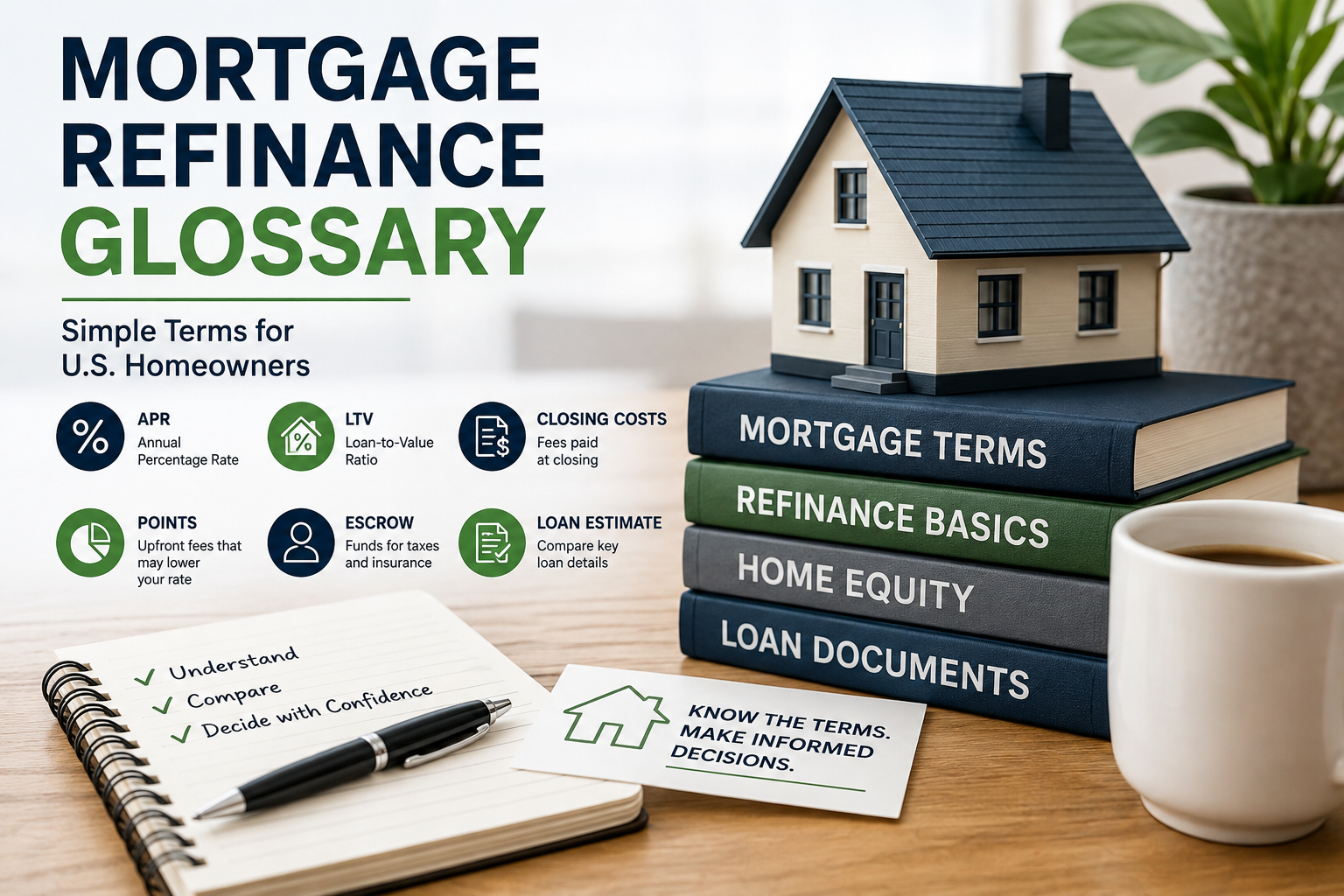
Mortgage refinancing comes with its own vocabulary. Terms such as APR, loan-to-value ratio, lender credits, rate lock, cash to close, underwriting, escrow, points, and Closing Disclosure can make a relatively straightforward decision feel much more complicated.
This Mortgage Refinance Glossary explains common U.S. mortgage and refinancing terms in plain English. It is designed to help homeowners understand the language they may encounter while researching refinance rates, comparing lender offers, reviewing Loan Estimates, or preparing for closing.
Understanding the terminology does not tell a homeowner whether refinancing is the right decision. It simply makes the documents and comparisons easier to understand.
Educational disclaimer: This Mortgage Refinance Glossary is provided by USRefiRates.com for general educational purposes only. USRefiRates.com is not a mortgage lender, mortgage broker, loan marketplace, credit provider, financial adviser, attorney, tax professional, or approval service. Definitions are simplified for general consumer understanding and may not describe every legal, regulatory, lender, state, or loan-program variation. Mortgage rates, APRs, costs, underwriting requirements, loan terms, insurance requirements, property rules, and available refinance programs vary. Always rely on the lender’s official disclosures and loan documents for the terms that apply to a particular mortgage.
Adjustable-Rate Mortgage — ARM
An adjustable-rate mortgage, usually called an ARM, is a mortgage with an interest rate that can change according to the terms of the loan.
An ARM may begin with an initial rate for a specified period and then adjust later. The loan documents explain the index, margin, adjustment periods, and limits on how much the rate can change.
Someone considering refinancing into an ARM should understand not only the starting rate but also how future adjustments could affect the payment.
Amortization
Amortization is the process of repaying a loan through scheduled payments over time.
With a typical amortizing mortgage, each principal-and-interest payment includes interest plus an amount that reduces the outstanding principal.
Earlier in the loan, a larger portion of the scheduled payment may generally go toward interest. As the balance declines, more of the scheduled payment can go toward principal.
Annual Percentage Rate — APR
APR stands for annual percentage rate.
APR is not the same as the mortgage interest rate. It is an annualized measure designed to reflect the cost of credit and incorporates certain charges associated with obtaining the loan.
Because APR can reflect more than the interest rate alone, it can be useful when comparing similar mortgage offers with different combinations of rates and certain finance charges. CFPB mortgage disclosures specifically distinguish APR from the interest rate.
Appraisal
An appraisal is a professional opinion of a property’s value.
A lender may require an appraisal during refinancing to help determine the property’s value and the relationship between that value and the proposed mortgage balance.
Not every refinance is handled identically, so homeowners should ask the lender what type of property valuation is required.
Appraised Value
Appraised value is the property value determined through an appraisal.
In a refinance, property value can affect the loan-to-value ratio and potentially influence available loan options, underwriting, mortgage insurance, and other requirements.
Break-Even Point
The break-even point is an estimate of how long it could take for expected refinance savings to recover the upfront costs of refinancing.
A simple calculation sometimes used for initial planning is:
refinance costs ÷ estimated monthly savings = approximate break-even period
This is only a starting point. It does not by itself account for every change in loan term, balance, equity, points, or long-term borrowing cost.
Cash-Out Refinance
A cash-out refinance replaces the existing mortgage with a larger new mortgage and allows the homeowner to receive part of the available equity as cash, subject to lender requirements.
Because the new mortgage balance increases, cash-out refinancing should be evaluated differently from refinancing that primarily changes the rate or term.
CFPB describes cash-out refinance transactions as replacing the original mortgage while increasing the amount borrowed against the home.
Cash to Close
Cash to close is the amount the borrower is expected to provide at closing after applicable costs, credits, payoffs, deposits, and other transaction amounts are calculated.
It is not necessarily the same as total closing costs.
The Loan Estimate and Closing Disclosure contain information that helps borrowers understand estimated or final cash-to-close amounts.
Closing
Closing is the stage at which the refinance transaction is completed and the required mortgage documents are signed or otherwise executed.
After a standard refinance closes and the transaction is completed, the new mortgage replaces the existing mortgage.
Closing procedures can vary according to lender, state, settlement process, and loan type.
Closing Costs
Closing costs are costs associated with completing the mortgage transaction.
They may include lender charges and third-party costs such as origination charges, appraisal-related fees, title services, government recording charges, prepaid items, and initial escrow amounts.
The exact combination varies by transaction.
Homeowners should compare closing costs alongside the interest rate, APR, loan term, cash to close, and new mortgage balance.
For a detailed breakdown, see refinance closing costs.
Closing Disclosure
The Closing Disclosure is an important mortgage document showing final information about the loan and closing costs for transactions subject to the applicable disclosure requirements.
It includes information such as the loan terms, projected payments, closing costs, APR, finance charge, and other calculations.
Comparing the Closing Disclosure with the earlier Loan Estimate helps borrowers identify changes before closing. CFPB provides official model and sample Closing Disclosures specifically for refinance transactions.
Conforming Loan
A conforming mortgage is generally a mortgage that meets applicable requirements for acquisition by Fannie Mae or Freddie Mac, including relevant loan limits and underwriting requirements.
A refinance does not automatically become better or worse merely because it is conforming. The actual rate, costs, term, and loan structure still need to be compared.
Conventional Mortgage
A conventional mortgage is a mortgage that is not insured or guaranteed by a federal government program such as FHA, VA, or USDA.
Conventional refinance requirements can vary according to lender, loan characteristics, borrower profile, and other factors.
Credit Report
A credit report contains information about a consumer’s credit history.
Mortgage lenders may obtain credit information when evaluating a refinance application.
A credit report is different from a credit score, although information from credit reports can be used in calculating credit scores.
Credit Score
A credit score is a number derived from information associated with a person’s credit history.
Mortgage lenders may use credit scores as one part of their assessment of a refinance application and loan pricing.
A credit score is important, but it is not necessarily the only factor considered.
Debt-to-Income Ratio — DTI
The debt-to-income ratio, commonly called DTI, compares qualifying monthly debt obligations with qualifying monthly income.
Lenders may use DTI as part of assessing a borrower’s ability to manage the proposed mortgage payment and other debts.
Exactly how income and debt are calculated can depend on lender and loan-program requirements.
Discount Points
Discount points are upfront charges paid to a lender in exchange for a lower mortgage interest rate.
One discount point equals 1% of the loan amount, although paying one point does not guarantee a specific reduction in the interest rate. The amount by which the rate changes depends on the lender, loan, and market conditions.
For example, one point on a $300,000 mortgage equals $3,000.
Whether paying points makes sense depends on the cost, rate reduction, expected time in the mortgage, and homeowner’s objectives.
Equity
Home equity is the difference between the value of a property and the debt secured against it.
For a simplified example, a house valued at $500,000 with a $300,000 mortgage balance would have approximately $200,000 of gross equity before considering transaction costs or other liens.
Equity can affect refinance options, particularly cash-out refinancing.
Escrow Account
An escrow account is an account associated with the mortgage that may be used to collect money for expenses such as property taxes and homeowners insurance.
A mortgage payment that includes escrow can therefore be higher than principal and interest alone.
CFPB mortgage disclosures distinguish principal and interest from estimated escrow and other components of the total monthly payment.
FHA Loan
An FHA loan is a mortgage insured through the Federal Housing Administration.
FHA mortgages have program-specific eligibility, underwriting, and mortgage-insurance requirements.
FHA refinancing options can differ from conventional refinancing, so homeowners with FHA loans should check the current FHA rules applying to their specific transaction. HUD confirms that most FHA forward mortgage programs involve mortgage insurance premiums.
Finance Charge
For mortgage disclosure purposes, the finance charge represents the cost of consumer credit expressed as a dollar amount under the applicable disclosure rules.
It can include interest and applicable loan charges.
The finance charge appears in the Loan Calculations section of the Closing Disclosure for covered mortgage transactions.
First Lien
A first lien generally has priority over later liens against a property.
A standard primary mortgage is commonly secured by a first lien.
Lien priority can matter when refinancing a property that also has a home equity loan, HELOC, judgment, or another claim against the property.
Fixed-Rate Mortgage
A fixed-rate mortgage has an interest rate that does not change during the loan term.
This provides predictability for the principal-and-interest portion of the mortgage payment.
Taxes, homeowners insurance, mortgage insurance, or other amounts included in the total payment can still change even when the mortgage interest rate is fixed.
Home Equity Line of Credit — HELOC
A HELOC is a revolving line of credit secured by the home.
A HELOC is different from a cash-out refinance.
A cash-out refinance replaces the existing mortgage with a larger mortgage. A HELOC generally exists as a separate credit line secured by the property rather than replacing the existing first mortgage.
Homeowners Insurance
Homeowners insurance is property insurance that can protect against covered losses involving the home and other risks specified by the policy.
Mortgage lenders generally require appropriate property insurance while their loan is secured by the home.
Homeowners insurance should not be confused with mortgage insurance.
Interest
Interest is the lender’s charge for lending money.
The mortgage interest rate helps determine the interest portion of the loan’s scheduled payments.
Interest rate and APR are related concepts, but they are not interchangeable.
Interest Rate
The interest rate is the percentage rate used in calculating interest on the mortgage balance.
A homeowner comparing refinance offers should consider the interest rate together with APR, points, lender credits, closing costs, loan term, and other loan features.
Jumbo Mortgage
A jumbo mortgage generally refers to a mortgage amount above the applicable conforming loan limit.
Because jumbo loans do not fit within standard conforming loan limits, lender requirements and pricing can differ from those for conforming mortgages.
Lender Credit
A lender credit is an amount provided by the lender that offsets some closing costs.
Lender credits typically involve accepting a higher interest rate than the borrower would receive without the credit.
They therefore represent a trade-off between lower upfront costs and potentially higher borrowing costs over time.
Lien
A lien is a legal claim or security interest attached to property.
A mortgage is secured against the home, giving the lender rights associated with that security interest.
Additional liens can affect a refinance because the lender and title professionals may need to determine which claims exist against the property.
Loan Amount
The loan amount is the amount of money being borrowed under the new mortgage.
In a refinance, the new loan amount can differ from the current outstanding mortgage balance because of cash-out proceeds, financed costs, payoffs, or other permitted transaction amounts.
Loan Estimate
The Loan Estimate is a standardized disclosure used for many consumer mortgage transactions.
It provides important estimated information such as the loan amount, interest rate, projected payment, estimated closing costs, and other loan features.
For a refinance, it allows homeowners to compare proposed loan structures before choosing which offer to pursue. CFPB publishes both blank and completed refinance-specific Loan Estimate examples.
Homeowners can also use mortgage refinance quotes to understand how written offers can be compared.
Loan Modification
A loan modification changes the terms of an existing mortgage.
It is different from refinancing.
With a mortgage refinance, a new loan replaces the old loan. With a loan modification, terms of the existing loan are modified rather than replaced through a standard new refinance mortgage.
Loan-to-Value Ratio — LTV
The loan-to-value ratio, or LTV, expresses the mortgage amount relative to the property’s value.
A simplified formula is:
loan amount ÷ property value × 100 = LTV
For example, a $320,000 mortgage on a property valued at $400,000 would represent an 80% LTV.
Lenders can use LTV when evaluating refinance eligibility, pricing, equity, mortgage-insurance requirements, and cash-out limits.
Loan Term
The mortgage term is the length of time scheduled for repayment of the loan.
Common examples include 15-year, 20-year, and 30-year mortgages, although other terms exist.
When refinancing, homeowners should compare the remaining term of the existing mortgage with the full term of the proposed replacement loan.
Restarting with a longer loan term can reduce the monthly payment while extending the repayment timeline. CFPB specifically notes the importance of understanding whether lower refinance payments result from lower rates or longer repayment periods.
Mortgage
In everyday U.S. consumer use, a mortgage generally refers to a loan secured by real property such as a home.
The property serves as security for the debt.
The exact legal documents and terminology associated with the security instrument can vary by jurisdiction.
Mortgage Insurance
Mortgage insurance generally protects the lender or mortgage investor against certain losses if the borrower does not repay as required.
The type and rules depend on the mortgage program.
For example, FHA loans use mortgage insurance premiums under FHA program rules, while conventional loans may involve private mortgage insurance in applicable circumstances.
Mortgage Refinance
A mortgage refinance is the process of obtaining a new mortgage that pays off and replaces an existing mortgage.
Homeowners may refinance to change the interest rate, payment structure, loan term, loan type, or amount borrowed.
Refinancing generally involves a new loan transaction and can involve closing costs and fees.
Mortgage Refinance Rate
Mortgage refinance rates are the interest rates associated with proposed mortgages used to refinance existing loans.
The rate offered to an individual borrower can depend on lender pricing, borrower characteristics, property details, loan amount, loan type, equity, and market conditions.
It should not be evaluated separately from APR and loan costs.
Mortgage Servicer
A mortgage servicer is the company responsible for administering the mortgage account.
Servicing activities can include receiving payments, maintaining account records, managing escrow, and communicating with the borrower.
The company servicing a mortgage is not necessarily the same company that originally made the loan.
Origination Charges
Origination charges are lender-related upfront charges associated with making the mortgage loan.
The Loan Estimate can itemize origination charges such as applicable underwriting, processing, application, or similar lender charges.
CFPB’s mortgage disclosure guidance specifically identifies origination charges as upfront charges from the lender for making the loan.
Payoff Amount
The payoff amount is the amount required to fully satisfy an existing mortgage as of a specified date.
It can differ from the principal balance shown on a normal monthly statement because it may account for accrued interest and other applicable amounts.
A refinance lender needs an accurate payoff figure because the existing mortgage must be satisfied as part of replacing it.
Points
In mortgage conversations, points often refer to discount points paid in exchange for a lower interest rate.
One point equals one percent of the loan amount.
Homeowners should confirm whether a lender is referring specifically to discount points and compare quotes using similar point structures.
Prepaid Interest
Prepaid interest is mortgage interest paid at closing for the period between closing and the beginning of the normal payment cycle.
It is classified separately from many lender fees on mortgage closing disclosures.
CFPB identifies prepaid interest as one of the common prepaid items shown in mortgage closing information.
Prepaids
Prepaids are amounts collected at closing for expenses that are paid in advance.
They can include items such as prepaid mortgage interest and certain insurance expenses.
They are not necessarily the same thing as lender charges.
Understanding that distinction can make refinance closing costs easier to interpret.
Prepayment Penalty
A prepayment penalty is a charge that may apply under certain mortgage contracts if the borrower pays off the mortgage early in circumstances covered by the loan terms.
Not every mortgage has one.
Homeowners considering refinancing should check their existing loan documents because refinancing normally involves paying off the previous mortgage.
Principal
Principal is the amount of mortgage debt owed before interest and certain other charges are considered.
As principal is repaid, the outstanding mortgage balance decreases.
On an amortizing mortgage, scheduled principal-and-interest payments generally include both repayment of principal and interest charged on the outstanding balance.
Principal and Interest — P&I
Principal and interest, sometimes abbreviated P&I, are the two core components of a standard amortizing mortgage payment.
Principal reduces the amount owed.
Interest is the cost of borrowing.
The total monthly housing payment may also include taxes, homeowners insurance, mortgage insurance, or escrow items.
Private Mortgage Insurance — PMI
Private mortgage insurance, commonly called PMI, is mortgage insurance that may apply to certain conventional mortgages.
It primarily protects the lender or investor rather than providing homeowners insurance protection for the borrower’s property.
PMI should not be confused with FHA mortgage insurance premiums or homeowners insurance.
Property Taxes
Property taxes are taxes assessed on real property by applicable local taxing authorities.
When a mortgage has an escrow account, part of the monthly payment may be collected to help pay property taxes when due.
Property taxes can change independently of whether the mortgage has a fixed interest rate.
Rate-and-Term Refinance
A rate-and-term refinance generally replaces an existing mortgage primarily to change the rate, repayment term, loan structure, or a combination of those features rather than principally taking additional home equity as cash.
CFPB research also refers to non-cash-out refinancing as rate-and-term refinancing.
Rate Lock
A rate lock is an agreement concerning the mortgage interest rate for a specified period, subject to the lender’s terms and applicable conditions.
A homeowner should check:
- Whether the rate is actually locked
- When the lock expires
- Whether the lock has a fee
- Whether it can be extended
- What application changes could affect the terms
A displayed or quoted rate should not automatically be assumed to be locked.
Refinance
To refinance means obtaining a new mortgage or other loan that replaces an existing obligation.
For a mortgage refinance, the new loan pays off and replaces the existing mortgage.
CFPB’s regulatory commentary describes a refinance purpose as refinancing an obligation already secured by the consumer’s dwelling to change the rate, term, or other loan features, with or without cash to the borrower.
For the full process, see how does refinancing a mortgage work.
Second Mortgage
A second mortgage is another loan secured by a property while a first mortgage remains in place.
Home equity loans are often structured as second-lien mortgages.
A second mortgage can matter during refinancing because lien priority and payoff or subordination requirements may need to be addressed.
Subordination
Subordination is an agreement affecting the priority of liens against a property.
It can become important when a homeowner has a second mortgage or HELOC and wants to refinance the first mortgage without paying off the secondary financing.
The lender holding the secondary lien may need to agree to remain behind the new first mortgage in lien priority.
Term
See Loan Term.
The term is the period over which the mortgage is scheduled to be repaid.
A new refinance term should always be compared with the time remaining on the existing loan.
Title
Title refers to legal ownership rights in real property.
As part of refinancing, title-related work may be performed to identify ownership, existing liens, and other matters affecting the property.
Title requirements and services vary by transaction and jurisdiction.
Title Insurance
Title insurance protects against certain covered title-related risks according to the terms of the policy.
A refinance transaction may involve lender’s title insurance because the new mortgage lender wants protection for its security interest.
Requirements and costs vary.
Total Interest Percentage — TIP
The Total Interest Percentage, or TIP, appears on applicable Loan Estimates and Closing Disclosures.
TIP represents the total scheduled interest over the life of the mortgage as a percentage of the loan amount, assuming payments are made as scheduled and the loan is kept for the full term.
TIP is not the same as the interest rate or APR.
Underwriting
Underwriting is the lender’s process of evaluating whether the borrower, property, and proposed mortgage meet the requirements for the loan.
The review can involve factors such as:
- Income
- Assets
- Credit
- Debts
- Property value
- Home equity
- Occupancy
- Loan purpose
- Supporting documentation
An advertised rate or early quote does not mean underwriting has been completed.
VA Loan
A VA loan is a mortgage made by an eligible lender and backed by the U.S. Department of Veterans Affairs for eligible borrowers.
VA refinance options have their own requirements and should be evaluated using the rules applying to the specific VA loan program.
Mortgage Refinance Glossary: How to Use These Terms
A Mortgage Refinance Glossary is most useful when the definitions are applied to real lender documents.
When reviewing a refinance offer, homeowners can identify the:
- Interest rate
- APR
- Loan amount
- Loan term
- Monthly principal and interest
- Estimated escrow
- Discount points
- Lender credits
- Origination charges
- Closing costs
- Cash to close
- Loan-to-value ratio
- Rate-lock status
- New mortgage balance
- Equity remaining after closing
The terms then stop being isolated definitions and become parts of one mortgage comparison.
Mortgage Refinance Glossary: Terms That Are Easy to Confuse
Several refinance terms sound similar but mean different things.
Interest rate vs APR: the interest rate is not the same as APR.
Principal and interest vs total monthly payment: taxes, insurance, mortgage insurance, or escrow can make the total payment higher.
Closing costs vs cash to close: these are related but not necessarily identical amounts.
Points vs lender credits: discount points generally involve paying more upfront for a lower rate; lender credits generally reduce upfront cost in exchange for different pricing, typically a higher rate.
Cash-out refinance vs HELOC: cash-out refinancing replaces the existing mortgage; a HELOC generally leaves the first mortgage in place.
Refinance vs loan modification: refinancing replaces the mortgage with a new loan; modification changes terms of the existing loan.
Recognizing these differences can prevent a homeowner from comparing two numbers or products as though they mean the same thing.
Final Takeaway
This Mortgage Refinance Glossary is designed to make mortgage terminology easier to understand, but definitions are only the beginning.
A refinance decision should be based on the actual loan documents and the complete structure of the proposed mortgage.
Before accepting an offer, homeowners should understand the interest rate, APR, loan term, points, lender credits, origination charges, closing costs, cash to close, monthly payment, rate-lock status, new mortgage balance, and effect on home equity.
Homeowners who prefer a digital application process can also review online mortgage refinance.
The more clearly those terms are understood, the easier it becomes to compare refinance offers without relying only on an advertised rate or monthly-payment figure.
Helpful Resources
For additional mortgage terminology and consumer education, use official resources from:
- Consumer Financial Protection Bureau — Mortgage Resources
- Consumer Financial Protection Bureau — Loan Estimate Guide
- Consumer Financial Protection Bureau — Closing Disclosure
- Consumer Financial Protection Bureau — Mortgage Key Terms
- U.S. Department of Housing and Urban Development — FHA Resources
Author Bio: USRefiRates Editorial Team
USRefiRates Editorial Team creates practical mortgage and refinance education for U.S. homeowners who want to understand rates, costs, loan structures, lender documents, and refinance terminology without unnecessary hype or pressure.
Copyright Notice
© 2026 – USRefiRates. All rights reserved.
This Mortgage Refinance Glossary is original educational content created for USRefiRates and may not be copied, scraped, spun, republished, redistributed, or used commercially without prior written permission. Brief quotations may be used with clear attribution to USRefiRates.
USRefiRates.com provides mortgage refinance, home loan, cash-out refinance, rate-and-term refinance, home-equity, closing-cost, lender-comparison, and related mortgage education for general informational purposes only.
Disclaimer: This Mortgage Refinance Glossary is intended only to explain common U.S. mortgage and refinancing terminology in plain language. USRefiRates.com does not provide loans, arrange mortgage financing, approve applications, set interest rates, or offer financial, legal, tax, or credit advice. The definitions on this page are simplified educational explanations and may not reflect every lender policy, loan program, regulatory requirement, state rule, or individual mortgage contract. Actual rates, APRs, fees, eligibility standards, insurance requirements, closing procedures, and loan terms can vary significantly. Always rely on the lender’s official Loan Estimate, Closing Disclosure, loan agreement, and other applicable documents when reviewing a specific refinance transaction.