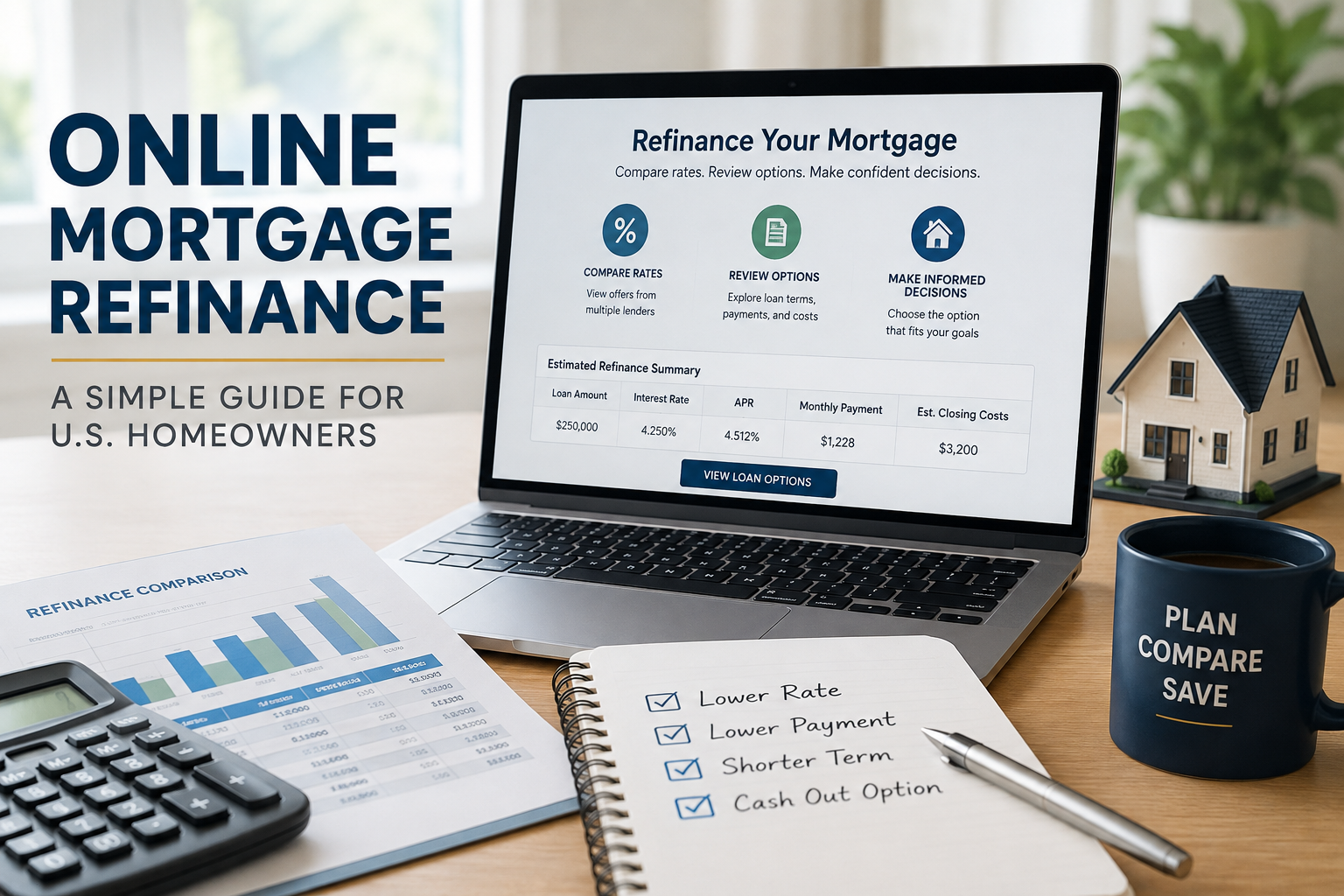
Online mortgage refinance gives homeowners a way to research, apply for, document, and manage much of a mortgage refinance through digital channels rather than relying primarily on branch visits. The underlying transaction is still a mortgage refinance: a new mortgage replaces the existing home loan, and the homeowner repays the new loan under the new terms.
The convenience can be valuable, but the decision still deserves the same care as any other mortgage. An online application does not remove underwriting, closing costs, loan disclosures, property requirements, or repayment obligations. Homeowners should compare the interest rate, APR, loan term, points, lender credits, closing costs, cash needed to close, rate-lock status, and the effect on the total borrowing path before accepting an offer.
Educational note: USRefiRates.com provides general mortgage refinancing education only and does not provide financial, legal, or tax advice. We are not a lender, broker, loan marketplace, or approval service. Mortgage rates, APRs, fees, loan terms, closing costs, approval requirements, technology options, and available refinance programs vary by lender, borrower profile, property, location, loan type, and market conditions. Always review official lender disclosures and closing documents before accepting a refinance offer.
Online Mortgage Refinance: Quick Answer
Online mortgage refinance generally means completing much of the refinance process through a lender’s website, app, secure portal, email, telephone support, or electronic document system.
Depending on the lender and transaction, a homeowner may be able to:
- Research refinance options online
- Request or compare loan information
- Submit an application
- Upload income and asset documents
- Authorize credit review
- Track application progress
- Review a Loan Estimate
- Communicate with the loan team
- Complete some disclosures electronically
- Review closing documents in advance
- Sign some documents electronically where available
Not every step is necessarily digital. Property valuation, notarization, identity verification, title work, settlement requirements, or closing procedures may involve other parties or offline steps. Technology-enabled mortgage closing can include electronic review and signing, but implementation varies.
The important point is that online mortgage refinance changes how the borrower interacts with the process. It does not change the need to understand the new mortgage.
What Online Mortgage Refinance Means
A mortgage refinance replaces an existing mortgage with a new mortgage. Homeowners who want the basic definition can start with what is mortgage refinancing.
With online mortgage refinance, more of the research, application, documentation, communication, and loan tracking may happen digitally.
The new lender may be the homeowner’s current lender or a different lender. The lender still evaluates the refinance request and decides whether the borrower and property meet the requirements for the proposed loan.
A digital process can reduce paperwork friction and make it easier to communicate or upload documents, but the financial decision remains the same: compare the proposed replacement mortgage with the existing mortgage and decide whether the change supports a clear goal.
Why Homeowners Consider Refinancing Online
Homeowners may prefer an online process because it can make research and document handling more convenient.
Potential advantages can include:
- Access to lender information without visiting a branch
- Easier document uploading
- Online status tracking
- Faster communication in some workflows
- Ability to compare written information from home
- Electronic delivery of certain disclosures and documents
- More time to review information independently before speaking with a lender
Convenience should not be confused with financial value.
A fast application is not automatically a good refinance. A polished website is not proof that a lender offers the best terms. A low advertised rate does not show the entire cost of the transaction.
Homeowners comparing online mortgage refinance options should judge the loan, not merely the technology used to deliver it.
How an Online Mortgage Refinance May Work Step by Step
The exact process varies, but many online refinance journeys follow a similar sequence.
Step 1: Review the Existing Mortgage
Before completing online forms, collect the basic facts about the current loan:
- Current mortgage balance
- Approximate payoff amount
- Current interest rate
- Remaining term
- Monthly principal-and-interest payment
- Fixed or adjustable rate structure
- Escrow information
- Mortgage insurance, if applicable
This gives the homeowner a baseline.
Step 2: Define the Refinance Goal
Decide what the refinance is supposed to accomplish.
Possible goals include:
- Changing the interest rate
- Changing the loan term
- Moving from an adjustable rate to a fixed rate
- Reducing monthly payment pressure
- Changing the repayment structure
- Accessing home equity
- Replacing a mortgage that no longer fits the household plan
An online mortgage refinance offer should be measured against that goal.
Step 3: Research and Compare Lenders
Homeowners can review lenders online, but comparing lenders should go beyond website design, testimonials, or headline rates.
Look for:
- Clear lender identity
- Licensing or registration information
- Contact information
- Explanation of fees and loan terms
- Secure document handling
- Written disclosures
- Clear privacy practices
- Accessible customer support
Homeowners can use NMLS Consumer Access to check whether a mortgage company or professional is authorized to conduct mortgage business in their state.
Step 4: Request Comparable Loan Information
When possible, ask lenders about similar loan structures so the comparison is meaningful.
For example, compare the same:
- Loan purpose
- Loan amount
- Fixed or adjustable structure
- Loan term
- Point structure
- Cash-out amount, if applicable
Homeowners can use the mortgage refinance quotes guide to organize written offers.
CFPB recommends requesting and comparing Loan Estimates from multiple lenders when shopping for a mortgage offer.
Step 5: Submit the Application
The online application may ask for information about:
- Identity
- Employment
- Income
- Assets
- Existing debts
- Current mortgage
- Property
- Occupancy
- Refinance purpose
- Desired loan amount
- Cash-out request, if applicable
The lender may also request authorization to obtain credit information.
Step 6: Upload Supporting Documents
A digital lender portal may allow the homeowner to upload financial and property documents.
Depending on the transaction, requested documents might include:
- Pay statements
- Tax documents
- Bank or asset statements
- Existing mortgage statement
- Insurance information
- Identification
- Other documents needed for underwriting
Homeowners should upload sensitive information only through channels they have verified as belonging to the lender or its authorized service provider.
Step 7: Review the Loan Estimate
For covered mortgage transactions, the Loan Estimate is a standardized disclosure that helps borrowers review important estimated loan terms and costs. CFPB describes it as a document containing important details about a mortgage loan the consumer has requested.
Homeowners should check:
- Loan amount
- Interest rate
- APR
- Monthly principal and interest
- Loan term
- Points
- Lender credits
- Origination charges
- Estimated closing costs
- Estimated cash to close
- Escrow information
- Whether the interest rate is locked
The digital format does not make these numbers less important. In an online mortgage refinance, the Loan Estimate remains one of the most useful documents for comparing the economics of competing offers.
Step 8: Complete Underwriting
The lender evaluates the borrower and property to determine whether the proposed refinance meets its requirements.
The review may include:
- Credit profile
- Income
- Assets
- Debts
- Debt-to-income position
- Property value
- Home equity
- Occupancy
- Loan purpose
- Documentation
A quick online prequalification, estimate, or rate display should not be treated as final approval.
Step 9: Review the Final Closing Information
Before closing, homeowners should review the final loan documents carefully and compare them with the earlier estimates.
Check whether important items changed, including:
- Interest rate
- Loan amount
- Monthly payment
- Closing costs
- Cash to close
- Points
- Lender credits
- Escrow
- Loan features
CFPB recommends reviewing mortgage closing documents in advance and checking the Closing Disclosure carefully.
If something is unclear or unexpected, ask the lender to explain it before signing.
Step 10: Complete Closing
Closing is when the required documents are signed and the refinance moves toward completion.
Depending on the lender, location, and transaction, some closing steps may be electronic while other parts may require a notary, settlement professional, attorney, title company, or in-person signing.
That is why “online” should not be interpreted as a promise that every refinance can be completed from beginning to end without any offline interaction.
Online Refinance vs Traditional Branch Refinance
The financial structure of the mortgage can be similar whether the borrower applies through a branch or through digital channels.
The biggest differences are often operational.
| Area | Online Process | Branch-Oriented Process |
|---|---|---|
| Research | Website or digital tools | Branch, phone, website |
| Application | Often online | Branch, phone, or online |
| Documents | Secure upload often available | Upload, email, mail, or branch |
| Communication | Portal, email, phone, chat | Phone, email, branch |
| Status tracking | Often digital | Varies |
| Closing | May be electronic, hybrid, or in person | Often in person or hybrid |
| Loan economics | Depends on lender and offer | Depends on lender and offer |
An online mortgage refinance is not automatically cheaper, faster, or better simply because the application is digital.
The homeowner still needs to compare the loan terms.
Mortgage Refinance Rates Online
Online rate displays can be useful for early research, but they may be based on assumptions that do not match a specific homeowner.
A displayed rate may depend on assumptions about:
- Credit profile
- Property type
- Occupancy
- Loan amount
- Home equity
- Loan term
- Discount points
- Refinance purpose
- Rate-lock period
For a broader rate comparison, see mortgage refinance rates.
Homeowners shopping for refinance online should look for the assumptions behind a displayed rate and compare borrower-specific written information rather than relying solely on advertising.
Interest Rate vs APR
The interest rate is not the same as APR.
The interest rate affects the cost of borrowing and helps determine principal-and-interest payments. APR provides a broader annualized measure because certain costs of obtaining the loan may be included.
That distinction matters when two online lenders display offers that look similar.
One offer may have a lower rate but require more points. Another may have a somewhat higher rate with fewer upfront finance charges or lender credits.
The homeowner should compare both the interest rate and APR along with the term, points, fees, credits, and expected time in the mortgage.
Points, Lender Credits, and Online Pricing
Discount points generally involve paying more upfront in exchange for a lower interest rate.
Lender credits can reduce some upfront closing costs in exchange for different pricing, often including a higher interest rate.
Online interfaces can make these trade-offs look simple, but the homeowner should make sure they are comparing like with like.
If one online mortgage refinance quote includes points and another does not, the rates are not directly equivalent.
Ask for comparable structures when practical.
Refinance Closing Costs
Online refinancing still has transaction costs.
Depending on the loan, costs may include:
- Lender or origination charges
- Appraisal-related costs
- Title services
- Settlement charges
- Recording charges
- Prepaid interest
- Escrow funding
- Other third-party charges
For a deeper cost breakdown, see refinance closing costs.
A digital application does not make legitimate closing costs disappear.
Some offers may use lender credits or financed costs to reduce the amount paid upfront. Those choices can change the rate, cash needed at closing, new loan balance, or longer-term cost.
Online Mortgage Refinance and Rate Locks
Mortgage rates can change before closing if they are not locked.
When reviewing an online offer, check whether the displayed or quoted rate is:
- An advertisement
- An estimate
- A personalized quote
- Locked
- Floating
If the rate is locked, review the expiration date and conditions.
Ask what happens if the refinance takes longer than expected, whether a lock extension costs money, and whether changes to the application could affect the terms.
The convenience of an online portal does not replace the need to understand the rate-lock agreement.
Online Mortgage Refinance and Home Equity
Home equity can affect refinance options, especially when the homeowner wants to take cash out.
A standard rate-and-term refinance generally focuses on replacing the existing mortgage to change the rate, term, or loan structure.
A cash out refinance replaces the existing mortgage with a larger new mortgage and allows the homeowner to receive part of the available equity as cash, subject to lender requirements.
Online mortgage refinance tools may make it easy to enter a desired cash amount, but that does not make the additional borrowing insignificant.
The homeowner should review:
- New mortgage balance
- Cash received
- Remaining equity
- Interest rate
- APR
- Loan term
- Closing costs
- Monthly payment
- Repayment risk
Home equity becomes mortgage debt when it is borrowed through a cash-out refinance.
Shorter Term vs Longer Term
The loan term can change the monthly payment and the total repayment path.
A shorter term may mean a higher required monthly payment but a faster scheduled payoff.
A longer term can reduce monthly payment pressure while extending the period the mortgage remains outstanding.
An online refinance calculator or quote screen may emphasize the new monthly payment. Homeowners should also compare the years remaining on the current mortgage with the full term of the proposed new loan.
A lower payment may be helpful without necessarily meaning the replacement mortgage costs less over the period the borrower keeps it.
Break-Even Thinking
A homeowner may estimate how long it could take for expected monthly savings to recover upfront refinance costs.
A simple planning calculation is:
refinance costs ÷ expected monthly savings = approximate break-even period
This is not a complete decision rule.
If the new mortgage changes the term, loan balance, equity position, or points paid, those factors should be considered as well.
For someone who expects to sell or refinance again relatively soon, a long break-even period may be particularly important.
How to Check an Online Mortgage Lender
A professional-looking website is not enough by itself.
Before sending sensitive financial documents, verify who you are dealing with.
Useful checks include:
- Confirm the company’s legal identity
- Review the lender or originator’s NMLS information where applicable
- Check that the company is authorized to conduct mortgage business in the relevant state
- Confirm contact information independently
- Look for a secure website connection
- Avoid sending sensitive documents to unexpected addresses or links
- Read privacy and data-handling information
- Be cautious of pressure, guarantees, or claims that seem unrealistic
NMLS Consumer Access provides a free public service for checking licensing and registration information for mortgage companies, branches, and professionals.
A digital refinance process should make communication easier, not make the lender’s identity harder to verify.
Warning Signs of Mortgage and Refinance Scams
Online convenience can also make it easier for misleading advertising, fake websites, impersonation attempts, or mortgage-relief scams to reach homeowners.
Be cautious when someone:
- Contacts you unexpectedly and claims to represent your lender or a government program
- Promises guaranteed mortgage relief or guaranteed savings
- Pressures you to act immediately
- Requests unusual payment methods
- Tells you to stop communicating with your lender
- Asks you to transfer ownership of your property
- Uses a website or email address that does not match the organization it claims to represent
- Refuses to provide clear written information
The FTC warns that mortgage-relief scammers may impersonate lenders or government-related programs, demand money upfront, or tell homeowners to stop communicating with their lender.
A genuine refinance decision should be based on verifiable lender information and written loan terms, not urgency or pressure.
Protecting Personal Information During an Online Refinance
Mortgage applications involve highly sensitive data.
Homeowners may provide identity information, income documents, bank information, tax records, and details about the property.
Basic precautions include:
- Navigate to the lender’s site independently rather than relying on unexpected links
- Check the web address carefully
- Use strong, unique passwords
- Enable multifactor authentication when offered
- Avoid uploading documents over unsecured public Wi-Fi
- Confirm unusual document requests with a known lender contact
- Keep copies of important disclosures and communications
- Report suspicious messages through the lender’s official contact channels
Online mortgage refinance can be convenient, but convenience should never require ignoring basic security.
Can a Mortgage Refinance Be Completed Entirely Online?
Sometimes much of the process can be digital, but homeowners should not assume that every transaction can be completed entirely online.
The amount of digital processing can depend on:
- Lender technology
- Settlement provider
- Property location
- State requirements
- Notarization rules
- Title requirements
- Loan program
- Whether an appraisal or other property review is needed
Some transactions may use electronic documents and electronic signatures extensively. Others may use a hybrid closing or require physical signatures for certain documents. CFPB has documented technology-enabled mortgage closings and electronic document review while emphasizing that borrowers still need to understand their closing documents.
The better question is not whether the refinance is “100% online.” It is whether the process is secure, understandable, and convenient for the borrower.
Common Online Mortgage Refinance Mistakes
Choosing a Lender Because the Website Looks Better
Design quality says little about the economics of the mortgage.
Comparing Advertised Rates Instead of Written Offers
Advertised rates can be based on assumptions that do not match the borrower.
Ignoring Points
A low rate may require more money upfront.
Looking Only at the Monthly Payment
A lower payment may come from extending the term.
Ignoring Closing Costs
A refinance can have transaction costs even when the application process is digital.
Uploading Sensitive Documents Too Quickly
Verify the lender and the upload channel first.
Assuming “Online” Means “Instant”
Underwriting, property review, title work, disclosures, and closing can still require additional steps.
Treating Prequalification as Final Approval
Early estimates are not the same as completed underwriting and final loan terms.
Borrowing More Equity Than the Goal Requires
Cash-out refinancing increases mortgage debt secured by the home.
Skipping Final Document Review
Convenience should not make the borrower rush through the Closing Disclosure or other final documents.
Example Online Refinance Scenarios
Scenario 1: Comparing a Shorter Term
A homeowner wants to pay off the mortgage faster.
The borrower uses online tools to request similar shorter-term offers from multiple lenders, then compares the rate, APR, payment, points, and closing costs.
The best-looking rate is not automatically selected. The homeowner considers whether the new monthly payment fits the household budget.
Scenario 2: Moving From Adjustable to Fixed
Another homeowner wants greater payment predictability.
The borrower compares fixed-rate offers online and reviews the interest rate, APR, loan term, closing costs, and rate-lock status.
The convenience of the online process helps with comparison, but the decision is driven by the loan structure.
Scenario 3: Lower Monthly Payment
A homeowner wants more monthly cash-flow room.
One online mortgage refinance offer produces a lower payment, but it also restarts the mortgage over a longer term.
The homeowner compares the short-term payment benefit with the longer repayment schedule before deciding.
Scenario 4: Cash-Out Refinance
A homeowner wants to access equity for a major planned expense.
The digital application makes it easy to model different cash amounts, but the borrower still reviews the larger mortgage balance, remaining equity, payment, term, fees, and repayment risk.
How to Prepare Before Applying Online
Before starting an application, gather the information likely to be useful.
This may include:
- Existing mortgage statement
- Approximate payoff amount
- Current interest rate
- Remaining loan term
- Property information
- Approximate property value
- Income information
- Asset information
- Existing debts
- Insurance information
- Refinance goal
- Desired loan amount
- Desired cash-out amount, if applicable
Also decide what matters most.
Is the priority:
- Payment stability?
- Shorter repayment?
- Lower monthly payment?
- Different interest-rate structure?
- Equity access?
- Lower upfront costs?
- Another specific goal?
Online mortgage refinance comparison becomes much easier when the homeowner knows what problem the new loan is supposed to solve.
Practical Next Steps
Start with the existing mortgage.
Then research legitimate lenders, verify who you are dealing with, and request comparable written offers where practical.
Use how does refinancing a mortgage work if you want a full explanation of the refinance process from application through closing.
Compare:
- Interest rate
- APR
- Loan amount
- Loan term
- Monthly payment
- Points
- Lender credits
- Closing costs
- Cash to close
- Costs financed into the loan
- Rate-lock status
- Home-equity impact
An online mortgage refinance should be chosen because the complete loan fits the homeowner’s goal, not because the application was the quickest or the website looked the easiest.
FAQs About Online Mortgage Refinance
What Is Online Mortgage Refinance?
Online mortgage refinance means completing much of the process of replacing an existing mortgage through digital channels such as lender websites, secure portals, electronic document systems, email, and phone support.
Is Online Mortgage Refinance Safe?
It can be, but homeowners should verify the lender or mortgage professional, use official secure channels, protect sensitive documents, and carefully review the loan disclosures before proceeding.
Can I Refinance My Mortgage Completely Online?
Some lenders can handle a large portion of the process digitally. Whether every step can be completed online depends on the lender, transaction, settlement process, property location, notarization requirements, and other factors.
Is an Online Refinance Cheaper Than a Branch Refinance?
Not automatically. The application channel does not determine whether the loan is cheaper. Compare the interest rate, APR, points, lender credits, closing costs, term, and total loan structure.
Is the Lowest Online Rate Always the Best Choice?
No. A lower rate may require discount points or come with different fees or terms. Compare the full written offer.
Can I Compare Several Online Mortgage Lenders?
Yes. Comparing similar written offers can make differences in rates, APR, points, lender credits, closing costs, and loan terms easier to identify. CFPB recommends comparing Loan Estimates when evaluating mortgage offers.
Does Applying for a Refinance Affect Credit?
A lender may obtain credit information as part of a mortgage refinance application. The effect on an individual credit profile can vary, so borrowers should review the lender’s application process and their own credit situation.
Do Online Refinance Lenders Still Require an Appraisal?
Property valuation requirements vary by lender, loan program, borrower, property, and transaction. Some refinances may involve an appraisal or another accepted valuation method.
What Should I Compare Before Choosing an Online Refinance?
Compare the existing mortgage with the proposed new loan amount, interest rate, APR, term, monthly payment, points, lender credits, closing costs, cash to close, financed costs, rate-lock status, and effect on home equity.
Final Takeaway
Online mortgage refinance can make the refinance process more convenient by moving research, applications, document uploads, communication, and some closing tasks into digital channels.
But the technology does not change the central financial decision.
The new mortgage still needs to be compared with the existing mortgage. Homeowners should understand the interest rate, APR, term, monthly payment, closing costs, points, lender credits, cash to close, rate-lock status, equity impact, and repayment path before accepting an offer.
The strongest online mortgage refinance experience is not simply the fastest one. It is the one in which the lender is verifiable, the process is secure, the written terms are understandable, and the replacement mortgage genuinely fits the homeowner’s goal.
Helpful Resources
- Consumer Financial Protection Bureau — Mortgage Resources Consumer Financial Protection Bureau — Loan Estimate Guide Consumer Financial Protection Bureau
- Compare Loan Offers Consumer Financial Protection Bureau — Mortgage Closing Guidance NMLS Consumer Access — Verify Mortgage Companies and ProfessionalsFederal Trade Commission — Loans and Mortgages
Author Bio: USRefiRates Editorial Team
USRefiRates Editorial Team creates clear, practical mortgage and refinance guides for U.S. homeowners who want to compare loan structures, costs, rates, and refinance options without hype or pressure.
Copyright Notice
© 2026 – USRefiRates. All rights reserved.
This article about online mortgage refinance is protected by copyright and may not be copied, scraped, spun, republished, or used for commercial purposes without prior written permission from USRefiRates. Brief quotations may be used with clear attribution and a link to the original article.
USRefiRates.com provides mortgage refinance, home loan, cash-out refinance, rate-and-term refinance, home equity, FHA loan, VA loan, closing cost, lender comparison, and related mortgage education for informational purposes only. Unauthorized reuse of this content, including AI rewriting, content spinning, bulk scraping, or republication on another website, is strictly prohibited.
Disclaimer: This guide is provided for general educational information about online mortgage refinancing in the United States. USRefiRates.com does not provide mortgage loans, arrange financing, match borrowers with lenders, or make lending decisions. We do not guarantee rates, approval, savings, closing times, or loan availability. Online refinance processes, lender requirements, fees, APRs, loan terms, property requirements, digital-document procedures, and closing methods can vary significantly by lender, borrower, loan program, property, and state. Any figures, examples, or comparisons should be treated as general illustrations only. Before submitting personal information or accepting a refinance offer, verify the lender, review the official Loan Estimate and closing documents carefully, and seek qualified financial, legal, or tax advice when appropriate.