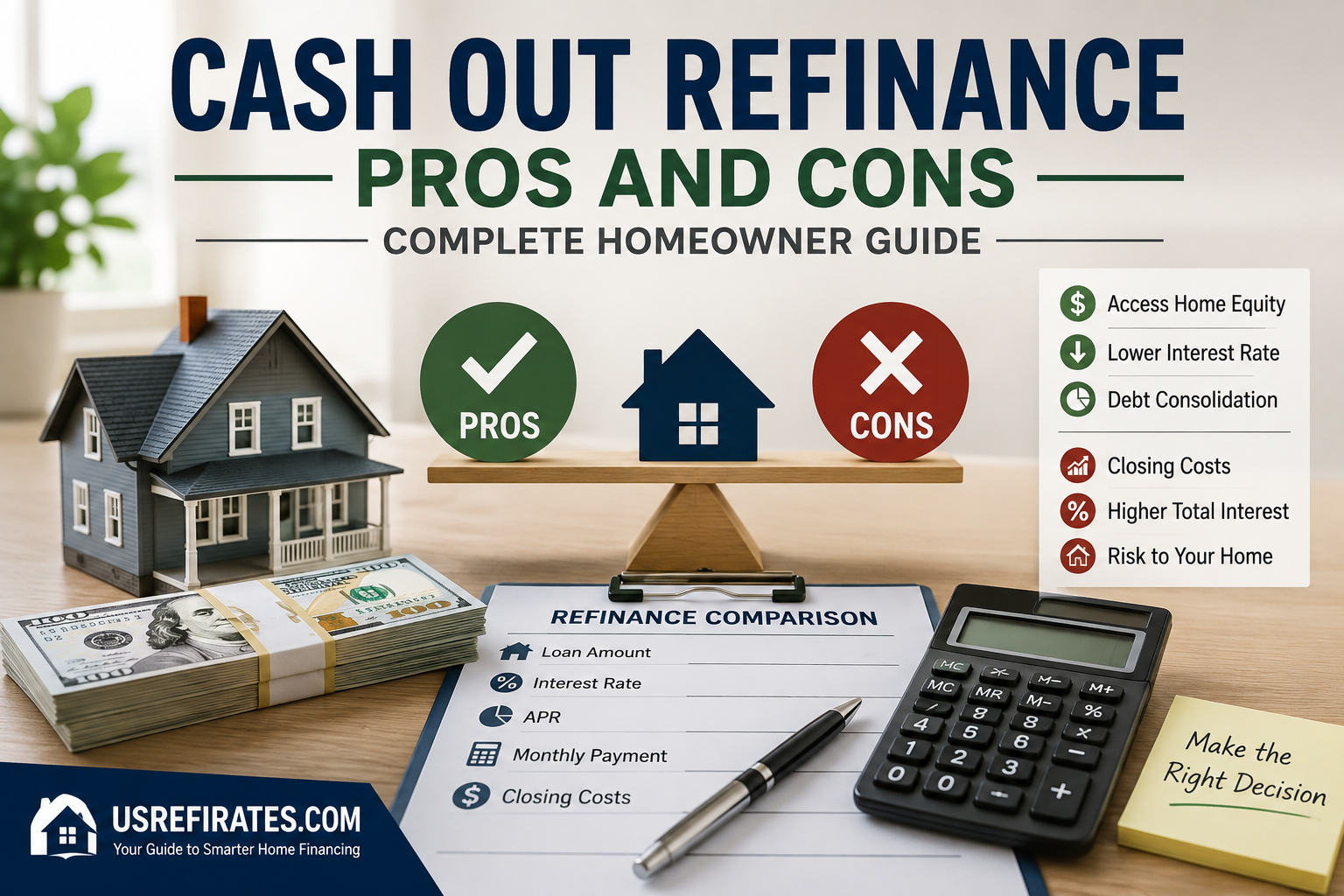
Cash out refinance pros and cons deserve careful comparison because a cash-out refinance does more than provide access to home equity. It replaces the existing mortgage with a larger new mortgage, and the homeowner receives part of the difference as cash after applicable payoffs and closing adjustments.
That can be useful when the money has a clear purpose, but the trade-off is important: equity that was previously part of the homeowner’s ownership position becomes debt secured by the home. The new loan may also change the interest rate, APR, monthly payment, loan term, closing costs, and total repayment path.
Educational disclaimer: This guide is provided by USRefiRates.com for general educational purposes only. USRefiRates.com is not a lender, mortgage broker, loan marketplace, credit provider, financial adviser, attorney, tax professional, or approval service. Cash-out refinance eligibility, rates, APRs, fees, loan-to-value limits, appraisal requirements, closing costs, tax consequences, and loan terms vary by lender, borrower, property, loan program, state, and market conditions. Examples are illustrative only. Always review the lender’s official Loan Estimate, Closing Disclosure, loan agreement, and other applicable documents before accepting a refinance offer, and seek qualified financial, legal, or tax advice when appropriate.
Cash Out Refinance Pros and Cons: Quick Answer
Cash out refinance pros and cons can be summarized in one central trade-off: the homeowner gains access to part of the equity in the property, but does so by replacing the current mortgage with a larger mortgage secured by the home.
Possible advantages can include:
- Access to a potentially large amount of home equity
- One new first-mortgage payment rather than adding a separate home-equity loan
- Ability to restructure the mortgage at the same time
- Potentially useful funding for major planned expenses
- A fixed-rate structure may be available, depending on the loan
- Possibility of consolidating some other debts into one mortgage payment
Possible disadvantages can include:
- A larger mortgage balance
- Less home equity after closing
- Closing costs
- A possible increase in the interest rate on the entire first-mortgage balance
- A longer repayment timeline if the term is restarted or extended
- More total interest over time in some scenarios
- Greater risk if unsecured debts are converted into debt secured by the home
- The possibility of losing the home if the new mortgage cannot be repaid
CFPB research specifically notes that cash-out refinancing increases the mortgage balance and that borrowers using home-secured debt to repay other debts can face greater foreclosure risk.
The decision should therefore be based on the complete replacement mortgage rather than the amount of cash received.
What a Cash-Out Refinance Actually Does
A cash-out refinance replaces an existing mortgage with a new loan that is larger than the amount needed to pay off the old mortgage. Subject to lender requirements and closing adjustments, part of the difference is paid to the homeowner as cash.
For example, a homeowner might have substantial equity because the mortgage balance has fallen, the property value has risen, or both. A lender may allow part of that equity to be borrowed through a larger replacement mortgage.
The important distinction is that cash-out refinancing is not a withdrawal from a savings account. The homeowner is borrowing against the property.
A detailed explanation of the basic structure is available in the cash out refinance guide.
Why Cash Out Refinance Pros and Cons Need a Full-Mortgage Comparison
Cash out refinance pros and cons can be misunderstood when the homeowner focuses only on the amount of cash they may receive.
The refinance affects the entire mortgage.
If the homeowner currently has a low-rate first mortgage and refinances into a higher-rate cash-out loan, the higher rate may apply not only to the new cash received but also to the existing balance that was refinanced. CFPB has specifically highlighted this potential disadvantage when comparing cash-out refinancing with products that leave an existing first mortgage intact.
That can make a cash-out refinance more expensive than an option that leaves the first mortgage untouched, depending on the available rates, fees, amount borrowed, and expected repayment period.
This is why the existing mortgage should always appear in the comparison.
Possible Pro: Access to Home Equity Without Selling the Home
One of the clearest potential advantages is the ability to convert part of home equity into cash without selling the property.
The funds may be considered for purposes such as:
- Major home repairs
- Renovation or accessibility work
- Large planned expenses
- Education costs
- Debt consolidation
- Other significant household needs
CFPB research has found cash-out borrowers using proceeds for purposes including debt repayment and home repairs.
The availability of cash can be useful, especially when the homeowner has substantial equity but limited liquid savings.
For that reason, cash out refinance pros and cons should be measured against the purpose of the funds and the cost of turning equity into mortgage debt.
However, the usefulness of the cash depends on what it costs to obtain and repay. A cash-out refinance should not be judged only by whether the homeowner can receive the desired amount.
Possible Pro: Restructuring the Mortgage at the Same Time
A cash-out refinance may also allow the homeowner to change features of the mortgage while accessing equity.
Depending on available loan options, the borrower may compare:
- Fixed-rate and adjustable-rate structures
- Different loan terms
- Different lenders
- Different monthly-payment structures
- Different point and lender-credit combinations
This can be useful when the existing mortgage no longer fits the homeowner’s goals.
But cash out refinance pros and cons should still be separated carefully. A useful mortgage restructure does not automatically make the additional equity borrowing inexpensive.
Possible Pro: One Mortgage Instead of Multiple Secured Loans
Some homeowners prefer a single first mortgage rather than maintaining the existing mortgage plus a separate home equity loan or HELOC.
A cash-out refinance can create one replacement mortgage rather than a second secured credit account. A HELOC or home equity loan, by contrast, can leave the original first mortgage in place.
That can make monthly administration simpler.
Simplicity, however, should not be confused with lower cost. Replacing the first mortgage may change the rate on the existing balance, while a second-lien product may leave the original first-mortgage rate in place. The homeowner should compare the cost of both structures rather than choosing solely because one produces a single payment.
Possible Pro: Debt Consolidation May Simplify Payments
Cash-out proceeds are sometimes used to repay credit cards, auto loans, or other debts. CFPB research has documented this use of cash-out refinance proceeds.
Consolidating several obligations into a mortgage can reduce the number of separate payments a household manages. In some situations, the mortgage rate may also be lower than rates on certain unsecured debts.
But this is one of the areas where cash out refinance pros and cons require the most caution.
Paying off unsecured debt with a mortgage does not erase the debt. It moves the obligation into debt secured by the home. CFPB warns that refinancing non-mortgage debts into home-secured debt can increase foreclosure risk if the mortgage later becomes unaffordable.
The homeowner should also consider whether paid-off credit accounts might be used again, which could leave the household with both a larger mortgage and new revolving balances.
Possible Con: The Mortgage Balance Becomes Larger
The most direct disadvantage is a larger mortgage balance.
The homeowner is borrowing more than is needed simply to pay off the current mortgage. The additional borrowing reduces the amount of equity remaining in the property.
A realistic cash out refinance pros and cons review therefore treats reduced equity as a real cost of the transaction, even though it does not appear as a separate fee.
Less equity can matter later if the homeowner:
- Wants to sell
- Wants to refinance again
- Experiences a decline in property value
- Needs another source of home-equity borrowing
- Wants to enter retirement with less mortgage debt
Cash out refinance pros and cons should therefore be considered not only in terms of today’s cash need but also the homeowner’s future balance sheet.
Possible Con: The Entire First-Mortgage Rate May Change
This can be one of the most important disadvantages and is easy to overlook.
Suppose a homeowner already has a large first-mortgage balance at an attractive rate. A cash-out refinance replaces that mortgage. If the new cash-out loan carries a higher rate, the homeowner may effectively reprice the entire refinanced balance at the new rate.
That is different from taking a HELOC or home equity loan that leaves the existing first mortgage in place. CFPB has highlighted this exact trade-off when discussing equity borrowing in a higher-rate environment.
For homeowners with an especially favorable existing mortgage, this comparison can materially change the economics of accessing equity.
Possible Con: Closing Costs
Cash-out refinancing can involve closing costs just like other mortgage transactions. CFPB notes that cash-out refinancing often involves closing costs, and the Loan Estimate provides standardized information about estimated mortgage costs.
Depending on the transaction, these may include:
- Lender or origination charges
- Appraisal-related costs
- Title services
- Settlement charges
- Recording fees
- Prepaid interest
- Escrow funding
- Other third-party charges
Some costs may be paid at closing. Some eligible costs may be financed into the loan, depending on the loan structure. Lender credits may offset some upfront costs in exchange for different pricing.
For a deeper breakdown, review refinance closing costs.
Financing closing costs can reduce the amount of cash required upfront, but it can also increase the mortgage balance.
Possible Con: A Longer Repayment Timeline
A homeowner may have already spent many years paying down the existing mortgage.
If that loan is replaced with a new 30-year mortgage, the scheduled repayment timeline may restart or extend substantially. CFPB research has identified longer loan terms as one concern associated with some cash-out refinances.
A lower monthly payment can therefore be misleading if it is created partly by spreading repayment over many more years.
When weighing cash out refinance pros and cons, compare:
- Years remaining on the current mortgage
- Term of the proposed new mortgage
- Existing monthly principal and interest
- New monthly principal and interest
- New loan balance
- Total costs
- Expected time in the new mortgage
A more comfortable monthly payment can still produce a longer debt horizon.
Possible Con: Home Equity Is Reduced
Home equity is the difference between the property’s value and debt secured against it.
Taking cash out increases secured debt and therefore reduces the homeowner’s equity position, all else equal.
This may not be a problem when the homeowner retains substantial equity and the borrowing supports a well-considered goal. But reducing equity can make the household more exposed to future property-price declines or limit later borrowing flexibility.
A cash out refinance calculator can help model the relationship between home value, existing balance, proposed new loan, estimated cash received, and remaining equity. It is a planning tool rather than a lender decision.
Possible Con: The Home Secures the New Debt
Mortgage debt is secured by the home.
That means cash-out refinancing can increase the stakes when funds are used to repay unsecured obligations.
A credit-card balance is generally unsecured. Once that debt is paid using cash from a larger mortgage, the amount is effectively incorporated into debt secured by the home.
This is why cash out refinance pros and cons should include repayment risk, not merely interest-rate comparisons.
If the homeowner later cannot meet the mortgage obligations, foreclosure risk can arise.
Interest Rate vs APR
The interest rate and APR should both be reviewed.
The interest rate helps determine the cost of borrowing and the principal-and-interest payment.
APR is a broader annualized measure that incorporates certain costs associated with obtaining the mortgage.
A lower interest rate does not necessarily mean the lowest overall-cost offer if it requires more discount points or other finance charges.
Homeowners comparing cash out refinance rates should review APR, points, lender credits, closing costs, loan term, and cash received along with the rate itself.
Points and Lender Credits
Discount points generally involve paying more upfront in exchange for a lower mortgage rate.
Lender credits can reduce some upfront closing costs in exchange for different loan pricing, commonly a higher interest rate. CFPB’s Loan Estimate guidance specifically advises borrowers to examine lender credits and their effect on the interest rate and total cost.
Cash out refinance pros and cons can look very different depending on which pricing structure is selected.
A homeowner expecting to keep the mortgage for many years may evaluate points differently from a homeowner who expects to move or refinance again relatively soon.
Compare similar structures where practical.
Loan-to-Value Ratio and Remaining Equity
Lenders may place limits on how much of the property’s value can be borrowed.
The loan-to-value ratio, or LTV, compares the mortgage amount with the property value.
A simplified calculation is:
loan amount ÷ property value × 100 = LTV
If a property is worth $500,000 and the proposed mortgage is $350,000, the simplified LTV is 70%.
The lender’s actual valuation, eligibility rules, and maximum cash-out limits depend on the loan program and transaction.
The important homeowner question is not only how much equity can be borrowed, but how much equity will remain afterward.
Fixed-Rate vs Adjustable-Rate Cash-Out Refinance
A fixed-rate mortgage keeps its stated interest rate unchanged for the term of the loan.
An adjustable-rate mortgage can change according to the loan terms after any applicable initial period.
When reviewing cash out refinance pros and cons, compare more than the starting payment.
For an adjustable-rate option, review:
- Initial-rate period
- Adjustment timing
- Index
- Margin
- Periodic caps
- Lifetime caps
- Potential future payments
The homeowner should choose a structure that fits both the expected time horizon and comfort with payment risk.
Cash-Out Refinance vs Rate-and-Term Refinance
A rate-and-term refinance generally focuses on replacing the existing mortgage to change the rate, term, or loan structure without primarily using the transaction to withdraw additional equity as cash.
A cash-out refinance adds a different objective: extracting equity. CFPB research distinguishes cash-out refinances from non-cash-out or rate-and-term refinances on this basis.
If the homeowner’s main goal is simply to change the mortgage rate or term, a rate-and-term refinance may deserve separate consideration.
Cash out refinance pros and cons become especially important when the homeowner is willing to increase the mortgage balance in order to receive cash.
Cash-Out Refinance vs HELOC
A HELOC and a cash-out refinance both allow homeowners to borrow against home equity, but the structures are different.
A cash-out refinance replaces the existing mortgage with a larger new mortgage.
A HELOC is generally a separate revolving line of credit secured by the home, so the existing first mortgage can remain in place.
That difference can be important when the homeowner already has a favorable first-mortgage rate.
A HELOC may have an adjustable interest rate and a separate payment structure, while cash-out refinancing can provide one replacement mortgage. Fees, rates, repayment rules, and risks should all be compared.
For a detailed side-by-side review, see HELOC vs cash out refinance.
This is one reason cash out refinance pros and cons should include at least one alternative that could leave the existing first mortgage in place.
Cash-Out Refinance vs Home Equity Loan
A home equity loan is generally a separate installment loan secured by the home rather than a replacement for the existing first mortgage. CFPB distinguishes home equity loans and HELOCs from cash-out refinances in this way.
That means the homeowner may keep the existing first mortgage and add a second payment.
A cash-out refinance instead replaces the current first mortgage.
Neither structure is automatically cheaper or safer.
The homeowner should compare:
- Rate on the existing first mortgage
- Rate on the proposed cash-out refinance
- Rate on the proposed home equity loan
- Fees
- Loan terms
- Monthly payments
- Amount borrowed
- Total cost
- Repayment risk
Cash Out Refinance Pros and Cons for Home Improvements
Using equity for major home repairs or improvements can have an understandable connection to the property securing the debt.
For example, a homeowner may need to replace a failing roof, address structural issues, improve accessibility, or complete another major project.
That does not mean every improvement justifies refinancing.
The homeowner should still compare the amount needed, project value, refinance costs, new mortgage rate, loan term, and alternatives.
Cosmetic spending or projects with uncertain value deserve especially careful consideration when they create long-term mortgage debt.
Cash Out Refinance Pros and Cons for Debt Consolidation
Debt consolidation can make a cash-out refinance look particularly attractive because high-rate unsecured debts may be replaced with one mortgage balance.
The possible benefit is simpler payment management and potentially different interest costs.
The major drawback is that the debt becomes connected to the home. CFPB has specifically warned about foreclosure risk when borrowers use mortgage debt to pay non-mortgage debts.
A household should consider:
- Whether the monthly payment actually improves
- Whether the mortgage term becomes much longer
- Whether closing costs offset the benefit
- Whether the new mortgage rate is higher than the existing first-mortgage rate
- Whether paid-off revolving accounts are likely to accumulate balances again
- Whether the household can comfortably make the new mortgage payment
A refinance should not be treated as a substitute for addressing the spending or cash-flow problem that created repeated unsecured debt.
Cash Out Refinance Pros and Cons for Emergency Funds
Using long-term mortgage debt to create a general emergency reserve deserves caution.
A genuine emergency expense can be unavoidable, but borrowing substantially more than is needed simply to hold cash can create a larger mortgage for many years.
If the goal is liquidity rather than a specific immediate expense, compare other available options and consider how much of the home’s equity should remain unborrowed.
The cost of accessing the money matters just as much as having the money available.
Comparing the Existing Mortgage With the New Mortgage
The strongest cash out refinance pros and cons analysis begins with a side-by-side comparison.
| Compare | Existing Mortgage | Proposed Cash-Out Refinance |
|---|---|---|
| Mortgage balance | Current | Larger new balance |
| Interest rate | Current | Proposed |
| APR | Current/available | Proposed |
| Remaining term | Current | New term |
| Monthly principal & interest | Current | Proposed |
| Closing costs | None to keep loan | Proposed refinance costs |
| Cash received | None | Proposed amount |
| Home equity | Current | Reduced after cash out |
| Rate structure | Current | Fixed/adjustable |
| Payoff date | Existing schedule | New schedule |
| Loan secured by home | Yes | Yes, larger balance |
This table helps keep the cash received from overshadowing what happens to the rest of the mortgage.
Comparing Lender Offers
When practical, compare written Loan Estimates from more than one lender.
The Loan Estimate provides a standardized way to review important loan terms and estimated costs. CFPB advises borrowers to compare Loan Estimates across lenders and review items including interest rate, monthly payment, upfront loan costs, lender credits and cash to close.
Compare:
- Loan amount
- Interest rate
- APR
- Monthly payment
- Points
- Lender credits
- Origination charges
- Other closing costs
- Estimated cash to close
- Cash to borrower
- Loan term
- Rate-lock status
If one lender’s offer looks dramatically better than another, identify why before assuming it is cheaper.
The difference may come from points, lender credits, loan term, rate-lock assumptions, fees, or another loan feature.
Rate Locks Matter
A quoted mortgage rate is not necessarily locked.
If the rate is floating, it can change before closing. Even a locked rate can change in certain circumstances if important application details change or the transaction does not close within the lock period.
If the lender offers a rate lock, review:
- The rate being locked
- Lock expiration date
- Whether points are locked
- Whether lender credits are locked
- Extension rules
- Extension costs
- What application changes could affect the terms
Cash out refinance pros and cons can change if the final rate or fees differ materially from the assumptions used when the homeowner first compared the transaction.
Break-Even Thinking
Homeowners sometimes estimate how long it could take for a refinance-related monthly benefit to recover upfront costs.
A simplified starting calculation is:
refinance costs ÷ expected monthly savings = approximate break-even period
For cash-out refinancing, this calculation can be less straightforward because the homeowner is also borrowing additional money.
If the new mortgage balance, rate, or term differs substantially from the existing mortgage, the homeowner should examine the complete cost structure rather than relying only on a simple payment-savings calculation.
Questions to Ask Before Taking Cash Out
Before choosing a cash-out refinance, ask:
- Why do I need the cash?
- How much do I actually need?
- What is my current mortgage rate?
- What rate would apply to the new mortgage?
- How much will the new mortgage balance be?
- How much equity will remain?
- What are the closing costs?
- Are any costs being financed?
- Are points being charged?
- Are lender credits changing the rate?
- What will my new monthly payment be?
- How many years remain on my current loan?
- What will the new loan term be?
- Is the rate fixed or adjustable?
- How long do I expect to keep the property?
- What alternatives could leave my current mortgage intact?
- Can I comfortably repay the new mortgage if household finances become tighter?
Cash out refinance pros and cons become much clearer when these questions have written answers.
Common Mistakes to Avoid
Focusing Only on the Cash Amount
The amount received is only one part of the transaction.
Ignoring the Existing Mortgage Rate
Replacing a favorable first mortgage with a higher-rate loan can increase the cost of the existing balance as well as the additional cash borrowed.
Looking Only at the Monthly Payment
A longer term can make the payment look more comfortable while extending repayment.
Ignoring Closing Costs
Mortgage refinancing is a transaction with costs.
Treating Equity as Free Money
Cash received through a refinance becomes mortgage debt.
Consolidating Debt Without Changing the Underlying Problem
Paying off credit cards does not prevent the balances from rebuilding later.
Borrowing More Than Is Needed
Every additional dollar borrowed increases the mortgage balance.
Ignoring Alternatives
A HELOC, home equity loan, rate-and-term refinance, personal loan, or simply delaying the expense may produce a different cost and risk profile depending on the situation.
Treating a Quote as Final Approval
A quote or early rate display is not the same as completed underwriting and final closing terms.
Simple Homeowner Scenarios
Scenario 1: Major Home Repair
A homeowner needs a substantial roof and structural repair.
The owner has significant equity and compares a cash-out refinance with a home equity loan. The decision considers the existing mortgage rate, the amount needed, fees, new payment, loan term, and whether replacing the entire first mortgage makes sense.
Scenario 2: Credit-Card Debt Consolidation
Another homeowner has several high-rate credit-card balances.
A cash-out refinance could simplify the payments, but the homeowner recognizes that unsecured balances would become part of mortgage debt secured by the home.
The borrower also examines whether the new mortgage rate would apply to a large existing first-mortgage balance and whether the spending pattern that created the credit-card debt has changed. CFPB research supports treating this debt-consolidation use with particular caution because of the added home-secured risk.
Scenario 3: Wanting General Spending Money
A homeowner has substantial equity and wants extra cash without a specific long-term purpose.
In this situation, cash out refinance pros and cons may lean more heavily toward caution because the homeowner would convert equity into long-term mortgage debt without a clearly defined use.
Scenario 4: Keeping a Very Low Existing Mortgage Rate
A homeowner has an attractive fixed rate on the current first mortgage but needs a smaller amount of equity.
Rather than assuming a cash-out refinance is best, the homeowner compares alternatives that may leave the existing mortgage intact.
The right result depends on the available rates, fees, amount needed, payment structure, and repayment plan.
How to Prepare Before Requesting Quotes
Gather:
- Current mortgage statement
- Approximate payoff amount
- Current interest rate
- Remaining loan term
- Property information
- Approximate property value
- Income documentation
- Asset information
- Existing debts
- Homeowners-insurance information
- Desired cash amount
- Purpose for the cash
Then decide what matters most.
Is the goal to fund a specific project, consolidate debts, restructure the mortgage, or solve another clearly defined problem?
The clearer the purpose, the easier it is to evaluate whether the added mortgage debt is justified.
Practical Next Steps
A written cash out refinance pros and cons comparison is easier to evaluate when the homeowner starts with the existing mortgage rather than the cash-out amount.
Start with the current balance, rate, payment, and remaining term.
Then estimate the cash actually needed and compare written lender offers where practical.
Review the Loan Estimates side by side. Look at the interest rate, APR, points, lender credits, closing costs, term, new loan balance, estimated cash to close, cash to borrower, and rate-lock status. CFPB specifically recommends using multiple Loan Estimates to compare mortgage offers.
Cash out refinance pros and cons should ultimately answer one question:
Does receiving this amount of equity as cash justify replacing the existing mortgage with this particular larger loan?
If the answer is not clear from the written numbers, more comparison is warranted before signing.
FAQs About Cash Out Refinance Pros and Cons
What Are the Main Cash Out Refinance Pros and Cons?
Cash out refinance pros and cons include access to home equity and the ability to restructure the mortgage, balanced against a larger loan balance, reduced equity, closing costs, repayment risk, and the possibility of changing the interest rate and term on the entire first mortgage.
What Is the Biggest Advantage of a Cash-Out Refinance?
The main potential advantage is access to a substantial amount of home equity through one replacement mortgage. Whether that is financially useful depends on the purpose of the funds and the terms of the new loan.
What Is the Biggest Risk of a Cash-Out Refinance?
A major risk is increasing debt secured by the home. The homeowner has a larger mortgage balance and less equity, and failure to meet the loan obligations can put the property at risk.
Can a Cash-Out Refinance Increase the Interest Rate on My Existing Balance?
Yes. Because the existing mortgage is replaced, the interest rate on the new cash-out mortgage applies to the refinanced loan balance under the new terms. This can be important when the existing mortgage has a significantly lower rate.
Does a Cash-Out Refinance Always Increase the Monthly Payment?
No. The payment depends on the new balance, interest rate, term, mortgage insurance if applicable, and other loan features. A longer loan term can sometimes reduce the scheduled payment even when the balance increases.
Is a Cash-Out Refinance Better Than a HELOC?
Not automatically. A cash-out refinance replaces the existing mortgage, while a HELOC generally creates a separate revolving credit line secured by the home. Rates, fees, payment structures, and risks differ.
Is Debt Consolidation a Good Reason for a Cash-Out Refinance?
It may be considered by some homeowners, but it requires caution. Moving unsecured debt into a mortgage can put the home at greater risk, and the household should consider the new mortgage term, total costs, and likelihood of accumulating new unsecured balances.
How Should Homeowners Compare Cash Out Refinance Pros and Cons?
Compare the existing mortgage with the proposed new loan. Review the rate, APR, loan balance, term, monthly payment, closing costs, points, lender credits, amount of cash received, remaining equity, rate-lock status, and alternatives.
Final Takeaway
Cash out refinance pros and cons should be judged as a complete mortgage decision, not as a simple way to withdraw money from a home.
The potential advantage is meaningful access to home equity while refinancing the first mortgage.
The potential disadvantages are equally important: a larger mortgage balance, reduced equity, closing costs, possible changes to the rate on the entire first-mortgage balance, a potentially longer repayment timeline, and greater risk when other debts are moved into a loan secured by the home.
The strongest cash out refinance pros and cons decision starts with the existing mortgage, identifies a clear reason for accessing equity, compares realistic alternatives, and uses written lender documents to evaluate the complete replacement loan.
Helpful Resources
CFPB Cash-Out Refinance Research
CFPB HELOC and Home Equity Guidance
FTC Credit, Loans and Debt Guidance
Freddie Mac Homeowner Education
Author Bio: USRefiRates Editorial Team
USRefiRates Editorial Team creates practical mortgage refinance education for U.S. homeowners who want to compare loan structures, home-equity options, borrowing costs, lender documents, and repayment risks without hype or pressure.
Copyright Notice
© 2026 – USRefiRates. All rights reserved.
This article about cash out refinance pros and cons is original educational content created for USRefiRates and may not be copied, scraped, spun, rewritten, republished, redistributed, or used commercially without prior written permission. Brief quotations may be used with clear attribution and a link to the original article.
USRefiRates.com provides mortgage refinance, cash-out refinance, home-equity, closing-cost, lender-comparison, rate-and-term refinance, and related home-loan education for general informational purposes only. Unauthorized bulk reuse, automated scraping, AI rewriting, or republication of this content on another website is prohibited.
Disclaimer
This article is provided for general educational purposes only. It is not financial, legal, tax, lending, accounting, real estate, or mortgage advice. Cash-out refinance terms, fees, rates, APRs, closing costs, approval requirements, escrow items, and available loan options vary by lender, borrower, property, equity position, and loan type. Homeowners should review the loan estimate, closing disclosure, and all official lender documents carefully before making a refinance decision. Speaking with qualified mortgage, legal, tax, or financial professionals may help homeowners understand how a refinance could affect their own situation.