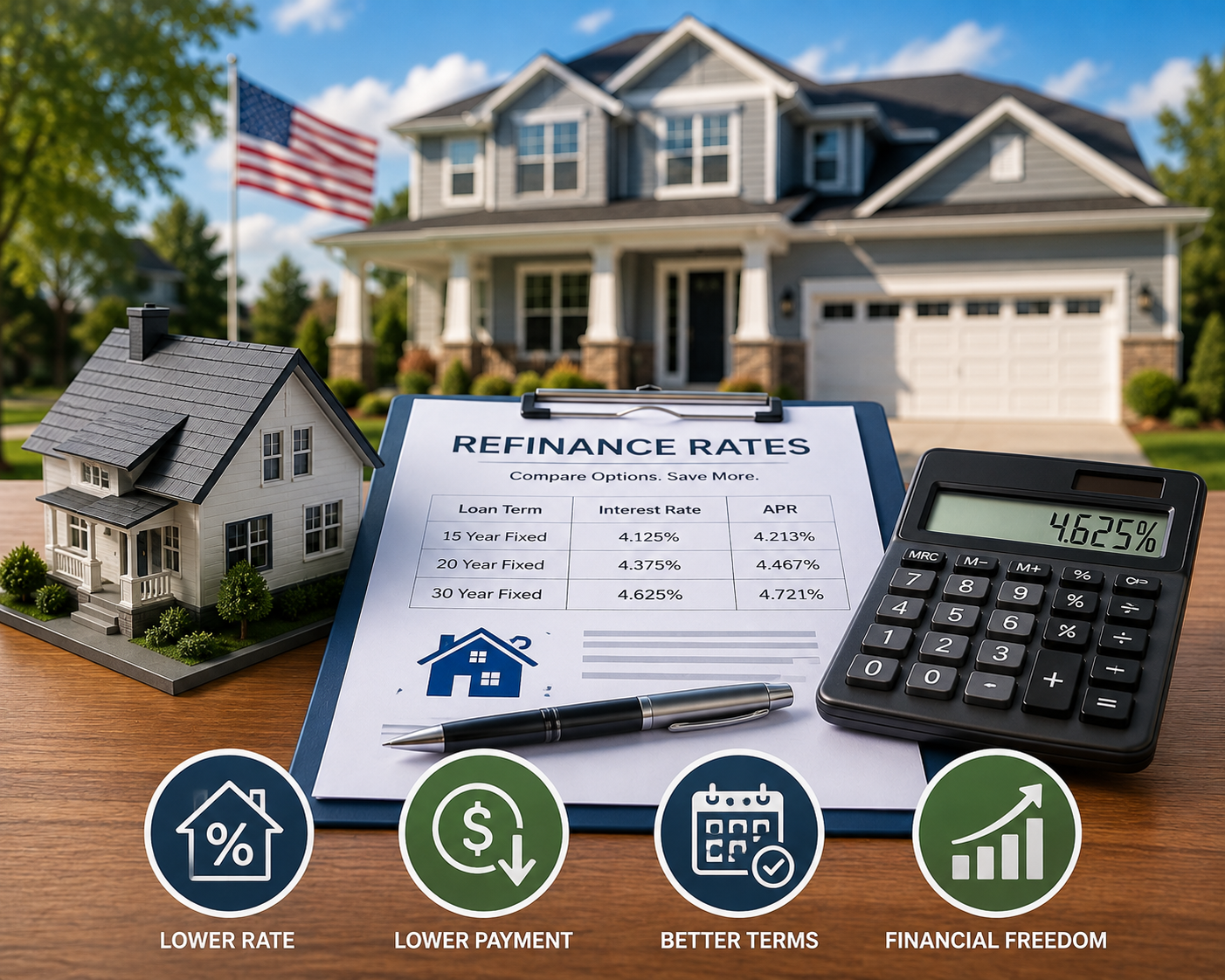
Rocket Mortgage Refinance Rates can help homeowners begin researching a mortgage refinance, but the advertised or published interest rate is only one part of the decision.
A refinance can change the mortgage rate, APR, repayment term, monthly payment, closing costs, loan balance, escrow arrangement, home-equity position, and expected payoff date.
That means the strongest comparison does not ask only:
What rate is available?
It asks:
What complete refinance offer is attached to that rate, and how does it compare with the mortgage already in place?
Homeowners researching Rocket Mortgage refinance rates should examine the rate together with APR, discount points, lender credits, fees, loan type, closing costs, repayment term, rate-lock status, and borrower-specific Loan Estimate before deciding whether refinancing makes sense.
Educational note: USRefiRates.com provides general mortgage refinance education only. We do not provide financial, legal, tax, accounting, lending, or real-estate advice. We are not a lender, mortgage broker, loan marketplace, credit provider, or approval service. Mortgage rates, APRs, points, lender credits, fees, closing costs, loan terms, property valuations, underwriting requirements, approval outcomes, and available refinance products can vary by lender, borrower, property, documentation, market conditions, location, and timing.
Independent note: USRefiRates.com is an independent mortgage refinance education website. We are not Rocket Mortgage, and this article is not sponsored by, endorsed by, or affiliated with Rocket Mortgage.
What Rocket Mortgage Refinance Rates Means
Rocket Mortgage Refinance Rates generally refers to mortgage refinance pricing published, quoted, or otherwise provided when a homeowner investigates refinancing through Rocket Mortgage.
A refinance-rate comparison can involve considerably more than one percentage.
Depending on the offer, homeowners may need to compare:
- interest rate
- APR
- discount points
- lender credits
- loan type
- loan term
- monthly payment
- closing costs
- cash to close
- rate-lock status
- mortgage balance
Published examples can be useful for preliminary research, but they should not automatically be treated as the rate an individual homeowner will receive.
Borrower-specific pricing can depend on the transaction and the lender’s evaluation.
Homeowners wanting a broader overview of the lender and refinance decision can review Rocket Mortgage refi.
Check 1: Read the Rate Assumptions
One of the biggest mistakes when comparing Rocket Mortgage refinance rates is looking at the interest-rate number without reading the assumptions attached to it.
A published rate may be connected with assumptions about:
- loan amount
- loan program
- repayment term
- discount points
- property type
- occupancy
- borrower qualifications
- loan-to-value
- refinance purpose
If those assumptions differ from the homeowner’s situation, the displayed example may not represent the pricing ultimately offered.
That is why a rate should be read together with its disclosures.
The number is only useful when the homeowner understands what conditions produced it.
Check 2: Compare Interest Rate and APR
Interest rate and APR are related but different.
The interest rate affects the interest charged on the mortgage principal.
APR provides broader information about borrowing cost because certain finance charges can be incorporated into the calculation.
That means two refinance offers can show similar interest rates while having different APRs.
The difference may be influenced by:
- points
- lender charges
- other applicable finance costs
When comparing Rocket Mortgage refinance rates, homeowners should therefore look at both numbers.
A lower interest rate with significantly higher upfront costs is not automatically a better deal than a slightly higher rate with fewer qualifying costs.
The complete pricing structure matters.
Check 3: Examine Discount Points
Discount points can materially affect the rate shown on a refinance offer.
Points generally involve paying additional money upfront in exchange for different mortgage pricing, commonly a lower interest rate.
Ask:
- How many points are required?
- What do the points cost?
- How much does the rate change?
- How much does the monthly payment change?
- How long might it take to recover the upfront expense?
- How long do I expect to keep the mortgage?
A homeowner comparing Rocket Mortgage refinance rates should avoid treating a rate requiring substantial points as directly equivalent to a rate requiring no points.
The cost of obtaining the rate belongs in the comparison.
Lender Credits Matter Too
Lender credits can work in the opposite direction.
A lender credit may reduce certain upfront closing costs while being associated with different mortgage pricing.
That can help a homeowner who wants to reduce immediate cash requirements.
But the trade-off should be understood.
Compare:
- lender-credit amount
- interest rate
- APR
- remaining closing costs
- monthly payment
- expected time in the mortgage
Neither points nor lender credits should automatically be considered good or bad.
They are pricing choices.
Check 4: Compare the Same Loan Type
Rocket Mortgage refinance rates can differ between loan structures.
That means homeowners should avoid comparing completely different products as though the only variable were the rate.
For example, a comparison might involve:
- 30-year fixed refinance
- 15-year fixed refinance
- adjustable-rate refinance
- conventional refinance
- FHA refinance
- VA refinance, where eligible
- jumbo refinance
- cash-out refinance
Different loan structures can have different pricing, qualification requirements, repayment characteristics, and risks.
The strongest comparison uses reasonably similar loan types.
A 15-year fixed refinance should not automatically be compared with a long-term adjustable-rate mortgage purely because one shows a lower starting rate.
Fixed-Rate Refinance
A fixed-rate refinance generally keeps the mortgage interest rate fixed according to the loan agreement.
That can make principal-and-interest payments more predictable.
Taxes, insurance, escrow amounts, and other housing expenses can still change.
When comparing Rocket Mortgage refinance rates for fixed-rate options, evaluate both:
- interest-rate pricing
- repayment term
A shorter fixed term can produce a different payment and borrowing-cost structure from a longer fixed term.
Adjustable-Rate Refinance
An adjustable-rate mortgage can change after its applicable initial period according to the loan terms.
Before comparing an adjustable rate with a fixed rate, understand:
- initial-rate period
- adjustment timing
- applicable index
- margin
- adjustment caps
- possible payment changes
- expected time in the property
A lower starting rate should not be evaluated without understanding what can happen later.
Check 5: Compare the Proposed Rate With the Existing Mortgage
This is one of the most important comparisons.
Before becoming focused on Rocket Mortgage refinance rates, write down the existing mortgage:
- current interest rate
- current principal balance
- remaining repayment term
- principal-and-interest payment
- fixed or adjustable structure
- approximate payoff amount
- expected payoff date
The proposed refinance is competing against this loan.
A new rate can look attractive while the refinance simultaneously:
- adds closing costs
- extends the repayment period
- increases the balance
- restarts a long mortgage term
The question should therefore be:
Does the complete replacement mortgage improve the homeowner’s position enough to justify replacing the existing mortgage?
Check 6: Add Closing Costs to the Comparison
The rate receives most of the attention, but refinancing creates a new mortgage transaction that can involve closing expenses.
Depending on the transaction, costs may include:
- lender charges
- origination-related charges
- discount points
- appraisal or valuation costs
- title-related charges
- settlement costs
- recording charges
- prepaid interest
- escrow funding
- other applicable costs
For a complete explanation, review refinance closing costs.
For the Rocket-specific cost picture, review Rocket Mortgage refinance cost.
Rocket Mortgage refinance rates should never be evaluated independently from the costs required to obtain the replacement mortgage.
Costs Paid Upfront vs Financed
Some eligible refinance expenses may be financed into the new mortgage when the transaction permits it.
That can reduce the amount of cash required at closing.
But financing costs can:
- increase the mortgage balance
- increase the amount being borrowed
- potentially increase interest paid over time
Paying more costs upfront can have the opposite effect:
- greater immediate cash requirement
- smaller replacement balance compared with financing those same eligible costs
A refinance should therefore be evaluated using both upfront cash requirements and longer-term borrowing cost.
Check 7: Compare Loan Term and Monthly Payment
A lower rate can reduce the monthly payment.
But a payment can also fall because the new mortgage has a longer repayment term.
Those are different outcomes.
Suppose a homeowner has already spent many years repaying a 30-year mortgage.
Starting another long-term mortgage may produce an attractive payment while extending the expected payoff date.
That does not automatically make the refinance a bad choice.
It means the homeowner should understand why the payment changed.
Compare:
- existing remaining term
- proposed new term
- existing payment
- proposed payment
- existing balance
- proposed balance
Rocket Mortgage refinance rates should be considered within that larger repayment picture.
Shorter Term vs Longer Term
Shorter Term
A shorter term may:
- increase the monthly payment
- accelerate principal repayment
- shorten time in mortgage debt
- potentially reduce total interest under suitable circumstances
Longer Term
A longer term may:
- reduce payment pressure
- improve immediate cash flow
- extend repayment
- potentially increase total interest
The most attractive interest rate does not automatically identify the most suitable term.
Check 8: Find Out Whether the Rate Is Locked
A quoted rate may not necessarily be locked.
Homeowners should ask:
- Is the rate locked?
- When does the lock expire?
- Are the points locked?
- Are lender credits locked?
- What could change the pricing?
- Can an extension cost money?
A rate lock can help protect stated pricing for an agreed period subject to its terms.
If the rate is not locked, market changes may affect the eventual pricing.
That makes rate-lock status an important part of comparing Rocket Mortgage refinance rates.
Check 9: Use the Loan Estimate for the Real Comparison
A published rate can help with research.
A borrower-specific Loan Estimate is much more useful for comparing actual mortgage proposals.
The Loan Estimate can show important information such as:
- loan amount
- interest rate
- projected payment
- closing costs
- cash to close
- estimated taxes and insurance
- important loan features
For covered transactions, CFPB guidance says the Loan Estimate generally must be provided within three business days after the lender receives the required application information. Receiving one does not mean the mortgage has received final approval.
The standardized format is specifically designed to make mortgage offers easier to compare.
Compare Loan Estimates From Multiple Lenders
The best rate research should eventually become a written offer comparison.
Try to request reasonably similar loans.
Align:
- loan amount
- loan purpose
- term
- fixed or adjustable structure
- cash-out amount, if applicable
- point assumptions
Then compare:
- interest rate
- APR
- points
- lender credits
- lender fees
- closing costs
- projected payment
- cash to close
- loan term
Homeowners wanting a broader framework for this process can review mortgage refinance quotes.
Rocket Mortgage Refinance Rates vs Rocket Mortgage Refi Rates
These two USRefiRates guides have different purposes.
This Rocket Mortgage Refinance Rates guide focuses on the broader comparison of Rocket refinance pricing across loan types, terms, costs and competing lender offers.
For a narrower explanation of how to interpret the assumptions behind displayed rate information, APR, points and rate examples, review Rocket Mortgage refi rates.
That keeps the two guides useful without making them duplicates.
Rate-and-Term Refinance Rates
A rate-and-term refinance generally replaces the existing mortgage primarily to change the interest rate, repayment term, mortgage structure, or a combination of those features.
The homeowner is normally focused on changing the existing mortgage rather than primarily taking additional equity as cash.
When comparing Rocket Mortgage refinance rates for a rate-and-term refinance, review:
- proposed rate
- APR
- points
- closing costs
- new repayment term
- new payment
- new balance
- existing mortgage being replaced
For broader information about the refinance structures themselves, review Rocket Mortgage refinancing.
Cash-Out Refinance Rates
Cash-out refinancing requires a different comparison.
A cash-out refinance generally replaces the existing mortgage with a larger mortgage and provides qualifying home equity as cash.
That means the homeowner should consider:
- interest rate
- APR
- cash received
- new mortgage balance
- remaining equity
- closing costs
- repayment term
- monthly payment
For broader rate education, review cash-out refinance rates.
The cash received is borrowed money secured by the home, so the rate should never be evaluated separately from the larger mortgage balance.
What Can Affect a Borrower’s Refinance Rate?
Individual mortgage pricing can vary.
Factors considered by lenders can include:
- credit profile
- loan amount
- property value
- loan-to-value ratio
- available equity
- debt-to-income ratio
- occupancy
- property type
- loan program
- refinance purpose
- discount points
- market conditions
Not every factor affects every loan in exactly the same way.
That is why a generic published rate should not be assumed to be a personal offer.
The borrower-specific documentation matters more.
APR Can Help Reveal Pricing Differences
Imagine two reasonably similar refinance offers.
The first has the lower interest rate but requires more points.
The second has a slightly higher rate but fewer qualifying finance charges.
Looking only at the interest rate can make the first offer appear automatically superior.
Looking at APR and the actual Loan Estimate reveals more information.
APR still does not answer every question.
The homeowner should also consider:
- loan term
- closing costs
- cash requirements
- expected time in the mortgage
No single number should control the entire decision.
Break-Even Thinking
Homeowners often want to know whether refinance costs can be recovered through an expected monthly benefit.
A simplified starting calculation is:
eligible upfront refinance costs ÷ expected monthly savings = approximate break-even period
This can help a homeowner judge whether substantial upfront costs make sense given the expected time in the new mortgage.
For example, a refinance with substantial upfront points may be less attractive if the homeowner expects to sell or refinance again before those costs have had time to be recovered through the projected monthly benefit.
Break-even analysis is only a planning tool.
It does not capture every possible change in:
- loan balance
- repayment term
- home value
- tax circumstances
- future rates
- homeowner plans
But it can help prevent a rate comparison from becoming too focused on the first month’s payment.
Published Rate vs Personal Rate
A published refinance rate is an example based on stated assumptions.
A personal refinance offer is based on the homeowner’s actual transaction and lender evaluation.
These should not be confused.
Rocket Mortgage’s official refinance-rate page displays rate information together with APR, points, payment examples and legal disclosures, demonstrating why the headline interest rate should be read together with the assumptions attached to it.
That is also why this USRefiRates article does not hard-code today’s Rocket Mortgage refinance rates into the evergreen body copy.
Rates can change.
Homeowners should verify current information directly rather than relying on an old number preserved in an article.
Compare Current Rocket Mortgage Pricing Directly
When current pricing matters, verify it through Rocket Mortgage’s official rate information.
Then examine:
- rate
- APR
- points
- loan type
- assumptions
- legal disclosures
Rocket’s published refinance pages currently show these items across multiple loan categories, reinforcing the importance of looking beyond one advertised percentage.
After that preliminary research, use the borrower-specific Loan Estimate for the actual loan comparison.
Closing Disclosure Check
The Loan Estimate is not the final document.
Later in the process, covered mortgage transactions use a Closing Disclosure containing the final loan terms and closing costs.
CFPB guidance says borrowers generally must receive the Closing Disclosure at least three business days before closing. This gives time to compare final figures with the earlier Loan Estimate and raise questions before completing the transaction.
Review:
- loan amount
- interest rate
- payment
- closing costs
- lender credits
- cash to close
- other important terms
If something changed unexpectedly, ask why.
Four Example Rate Comparisons
Example 1: Lower Rate With More Points
A homeowner sees an attractive refinance rate.
The Loan Estimate shows that achieving it requires substantial discount points.
The homeowner compares:
- point cost
- payment reduction
- APR
- break-even period
- expected time in the mortgage
The lower rate may still be worthwhile, but the homeowner is now comparing the entire pricing structure.
Example 2: Slightly Higher Rate With Lower Upfront Cost
Another homeowner prefers to preserve cash.
A competing offer has a slightly higher interest rate but significantly lower upfront expense.
The homeowner evaluates:
- rate difference
- APR
- closing costs
- monthly-payment difference
- expected time in the mortgage
The lower headline rate is no longer automatically the winner.
Example 3: Lower Payment With a Longer Term
A homeowner is attracted to a lower monthly payment.
The new mortgage also substantially extends the repayment period.
The homeowner compares:
- payment relief
- new payoff date
- closing costs
- total repayment timeline
The new structure may still fit the homeowner’s goal, but the trade-off is understood.
Example 4: Cash-Out Rate Comparison
A homeowner wants access to equity.
The proposed cash-out refinance has a different rate and a larger balance than the existing mortgage.
The homeowner compares:
- rate
- APR
- cash received
- new balance
- remaining equity
- closing costs
- term
The rate is now only one part of a much larger borrowing decision.
Common Rocket Mortgage Refinance Rates Mistakes
Looking Only at the Headline Rate
The headline rate does not reveal APR, points, fees or assumptions.
Ignoring Points
The cost required to obtain a rate belongs in the comparison.
Ignoring APR
APR provides additional information about certain borrowing costs.
Comparing Different Loan Types
A 15-year fixed mortgage and an adjustable-rate mortgage are not equivalent offers.
Ignoring Closing Costs
The rate does not tell the homeowner what the new transaction costs to complete.
Forgetting the Existing Mortgage
The new loan should be compared with the mortgage it would replace.
Looking Only at Monthly Payment
A longer term can reduce the payment while extending the debt.
Assuming a Published Rate Is a Personal Offer
Actual borrower pricing depends on the individual transaction.
Ignoring Rate-Lock Status
A quoted rate may not necessarily be locked.
Failing to Compare Loan Estimates
Written standardized offers provide a stronger comparison than advertisements.
Rocket Mortgage Refinance Rates Checklist
Before choosing a refinance based on rate information, understand:
- existing mortgage rate
- existing mortgage balance
- existing remaining term
- proposed interest rate
- APR
- discount points
- lender credits
- loan type
- fixed or adjustable structure
- proposed mortgage balance
- closing costs
- costs being financed
- cash to close
- proposed payment
- new repayment term
- rate-lock status
- expected time in the mortgage
- refinance purpose
If one of these items is unclear, the rate comparison is not complete.
FAQs About Rocket Mortgage Refinance Rates
Are Rocket Mortgage Refinance Rates the Same for Every Homeowner?
No. Borrower-specific refinance pricing can vary according to the loan, borrower, property, lender evaluation and market conditions.
Should I Compare Rocket Mortgage Refinance Rates With APR?
Yes. Comparing both the interest rate and APR provides more information than relying on the interest rate alone.
Can Discount Points Affect Rocket Mortgage Refinance Rates?
Yes. Discount points can be associated with different interest-rate pricing and increase upfront cost. Compare the cost of the points with the rate and expected time in the mortgage.
Are Published Rocket Mortgage Refinance Rates Guaranteed?
No. Published rate examples should not automatically be treated as a guaranteed borrower-specific offer. Review the assumptions and obtain written loan information for the actual transaction.
Should I Compare Rocket Mortgage Refinance Rates With Other Lenders?
Yes. Compare reasonably similar Loan Estimates from multiple lenders using the same loan purpose, term and structure wherever practical.
Do Closing Costs Matter When Comparing Refinance Rates?
Yes. A lower rate can still be associated with substantial closing costs, points or other charges. Compare the full cost of obtaining the refinance.
Can a Longer Loan Term Make a Lower Rate More Expensive Overall?
A longer repayment term can extend the period over which mortgage interest is paid. Compare the monthly payment and the total repayment timeline.
Does Cash-Out Refinancing Use the Same Rate as Rate-and-Term Refinancing?
Not necessarily. Loan purpose and structure can affect pricing and eligibility. Compare the actual written terms for each transaction.
Should I Check Whether a Refinance Rate Is Locked?
Yes. Determine whether the rate is locked, when the lock expires and whether points or lender credits are included in the lock.
What Is the Best Way to Compare Rocket Mortgage Refinance Rates?
Compare reasonably similar written Loan Estimates using interest rate, APR, points, lender credits, closing costs, loan term, mortgage balance, payment and cash to close.
Final Takeaway
Rocket Mortgage Refinance Rates should be evaluated as part of the complete mortgage offer rather than as a stand-alone percentage.
Start with the existing mortgage.
Then compare:
- interest rate
- APR
- points
- lender credits
- loan type
- closing costs
- mortgage balance
- monthly payment
- repayment term
- rate-lock status
- Loan Estimate
- competing lender offers
A lower rate can be valuable, but it does not automatically make a refinance better.
The strongest decision comes from understanding what it costs to obtain the rate, what mortgage structure comes with it, and whether the complete replacement loan improves the homeowner’s position.
Helpful Resources
- Rocket Mortgage refinance rates
- CFPB mortgage resources
- CFPB Loan Estimate guide
- CFPB Closing Disclosure guide
- FTC credit and loan guidance
- HUD housing resources
Author Bio
USRefiRates Editorial Team
USRefiRates Editorial Team publishes independent educational material about U.S. mortgage refinancing, refinance rates, APR, loan terms, closing costs, home equity, lender comparison and homeowner mortgage decisions.
Copyright Notice
© 2026 – USRefiRates. All rights reserved.
This Rocket Mortgage Refinance Rates guide is original educational content published by USRefiRates. It may not be copied, scraped, spun, republished, redistributed or used for commercial publishing without prior written permission.
Brief quotations may be used with proper attribution and a clear link to the original USRefiRates article.
Unauthorized bulk scraping, automated republication, AI rewriting, content spinning or reproduction of this article on another website is prohibited.
Educational Disclaimer
This Rocket Mortgage Refinance Rates guide is provided for general educational and informational purposes only. It is not financial, legal, tax, accounting, lending, real-estate or mortgage advice.
USRefiRates.com is not Rocket Mortgage and is not sponsored by, endorsed by or affiliated with Rocket Mortgage. Rocket Mortgage is a third-party lender and brand referenced for educational comparison purposes.
USRefiRates.com is not a lender, mortgage broker, loan marketplace, credit provider, financial adviser, attorney, tax professional or approval service.
Mortgage rates, APRs, points, lender credits, closing costs, loan amounts, property valuations, equity requirements, underwriting standards, repayment terms, rate-lock conditions, available products and approval outcomes vary according to lender, borrower, property, documentation, loan program, location, market conditions and timing.
Homeowners should review the lender’s official Loan Estimate, Closing Disclosure, rate-lock information, loan agreement and other applicable disclosures before making a refinance decision. Qualified professional guidance should be obtained where appropriate.
Thanks for your comment. Rocket Mortgage home refinance rates can change based on loan type, credit profile, equity, points, and market conditions, so comparing the full Loan Estimate matters. USRefiRates is not affiliated with Rocket Mortgage. You may also find this helpful: Rocket Mortgage home refinance rates.
Thanks for your comment. Rocket Mortgage home refinance rates can change based on loan type, credit profile, equity, points, and market conditions, so comparing the full Loan Estimate matters. USRefiRates is not affiliated with Rocket Mortgage. You may also find this helpful: Rocket Mortgage home refinance rates.