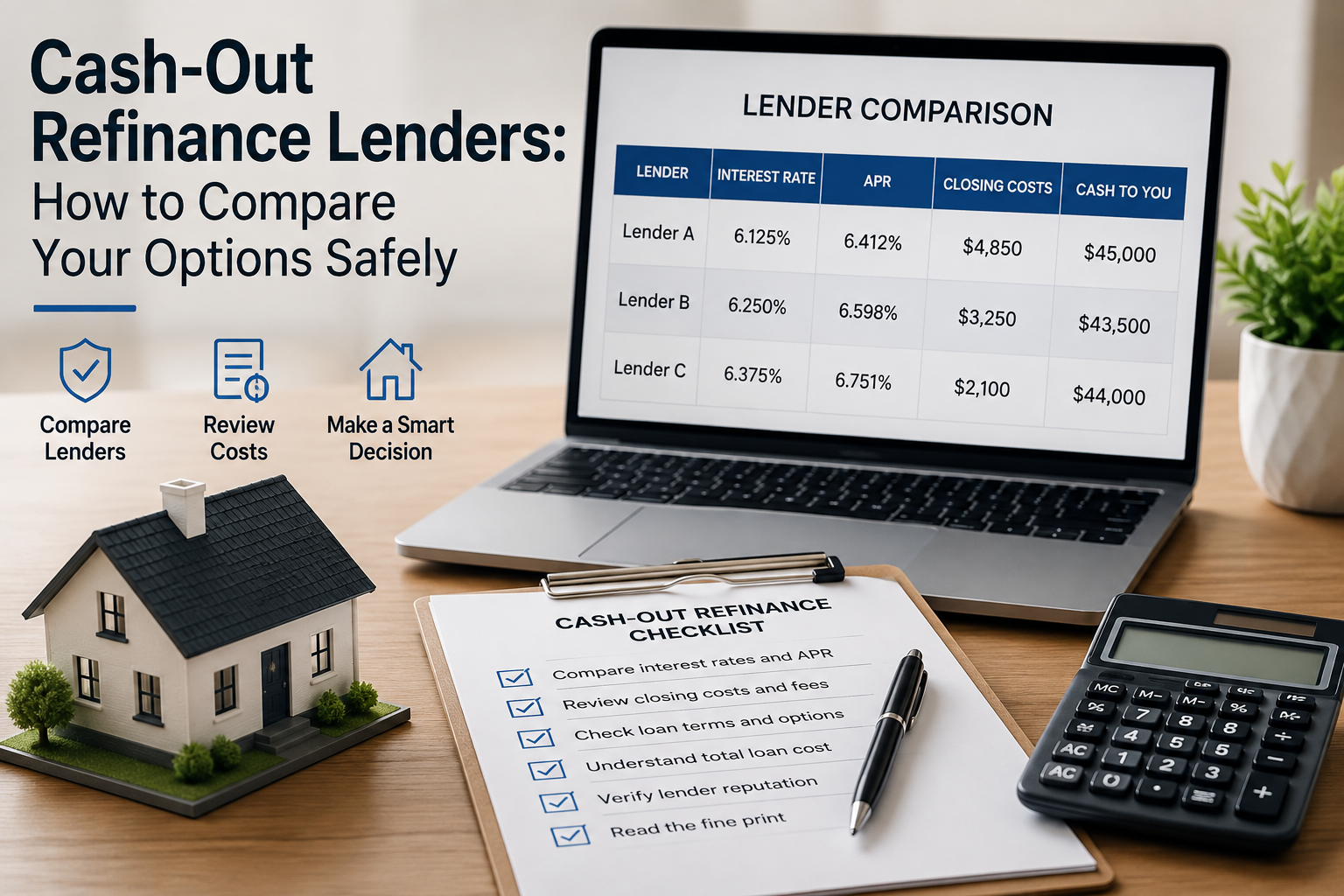
Cash-Out Refinance Lenders can look similar at first, but the details behind each offer may affect your home equity, monthly payment, loan term, closing costs, and total mortgage cost. A cash-out refinance may help some homeowners access equity, but it is still a new mortgage. That means the lender choice deserves more than a quick skim and a hopeful nod.
Educational note: USRefiRates.com provides general mortgage refinancing education only and does not provide financial, legal, or tax advice. We are not a lender, broker, loan marketplace, or approval service. Mortgage refinance rates, APRs, fees, loan terms, closing costs, approval requirements, and savings estimates vary by lender, borrower profile, credit score, property type, loan amount, location, and market conditions. Always review the lender’s official loan disclosures, closing documents, and full loan agreement carefully before accepting any refinance offer.
Related guide: cash-out refinance
Cash-Out Refinance Lenders to Compare
Homeowners researching cash-out refinancing may encounter lenders such as Rocket Mortgage, Pennymac, and loanDepot. Each lender has its own eligibility requirements, rates, APRs, fees, loan programs, equity requirements, and closing-cost structure.
| Lender | Cash-Out Refinance Available | What to Compare |
|---|---|---|
| Rocket Mortgage | Yes | Rate, APR, closing costs, credit requirements, loan term, and available equity |
| Pennymac | Yes | Loan type, LTV requirements, rate, APR, fees, closing costs, and repayment terms |
| loanDepot | Yes | Rate, APR, lender fees, loan program, closing costs, and cash-out amount |
Last verified: August 18, 2026
USRefiRates does not recommend or endorse a particular lender. Availability, eligibility, pricing, loan programs, and terms can change. Homeowners should verify current information directly with each lender and compare written Loan Estimates before choosing a refinance offer.
What Cash-Out Refinance Lenders Are
Cash-Out Refinance Lenders are mortgage lenders that may offer refinance loans allowing eligible homeowners to convert part of their home equity into cash. The new loan replaces the existing mortgage, pays off the old balance, and may provide cash to the borrower after closing costs, payoff amounts, escrow items, and other charges are handled.
This differs from a rate-and-term refinance, which usually changes the loan rate, term, or structure without taking extra equity out. A cash-out refinance may increase the mortgage balance, so long-term cost matters.
For the bigger picture, homeowners can review cash-out refinance before comparing lender quotes.
Why Homeowners Compare This Option
Homeowners compare Cash-Out Refinance Lenders because pricing, fees, loan terms, escrow handling, and underwriting standards can vary. One lender may show a lower interest rate with higher upfront costs. Another may show fewer fees but a higher APR.
Common reasons include home repairs, debt consolidation, household expenses, or simplifying several payments into one mortgage payment. The risk should stay clear: the cash is borrowed against the home, and missed mortgage payments can create serious consequences.
How This Refinance May Work
When a homeowner requests quotes from Cash-Out Refinance Lenders, the lender may review property value, mortgage payoff, credit profile, income, debts, payment history, and available equity. Requirements vary by lender, loan type, borrower profile, and property.
If the borrower moves forward, the lender provides a Loan Estimate. That document helps homeowners review the loan amount, interest rate, APR, projected payment, closing costs, prepaid items, escrow information, and cash to borrower.
The best-looking quote is not always the safest one. Cash-Out Refinance Lenders should be compared by total cost, loan term, repayment risk, APR, fees, and remaining equity.
How Lenders May Compare Borrowers
Cash-Out Refinance Lenders may look at credit history, income stability, debt-to-income profile, home value, property condition, payment history, occupancy, loan purpose, and remaining equity.
Credit can affect whether a borrower qualifies and how a lender prices the loan. Income and debt review can affect whether the payment appears manageable. Home equity and property value can affect how much cash may be available.
This should not be treated as a fixed checklist. Lender rules, loan programs, documentation standards, and pricing can vary.
Interest, APR, Points, Fees, Escrow, and Total Loan Cost
Cash-Out Refinance Lenders should never be judged by interest rate alone. The interest rate affects the monthly payment, but APR can help show a broader cost picture because it includes certain loan costs. Points, lender fees, third-party charges, prepaid items, escrow deposits, and title-related costs may also affect the final decision.
A quote with a lower interest rate may include points or higher upfront costs. A quote with fewer upfront costs may cost more over time. Closing costs rolled into the loan can reduce upfront pressure, but they may increase the loan balance.
Compare monthly payment, APR, closing costs, loan term, and total loan cost together. For deeper rate comparison context, see cash-out refinance rates.
Fixed-Rate vs Adjustable-Rate Options
Some Cash-Out Refinance Lenders may offer fixed-rate loans, adjustable-rate loans, or both. A fixed-rate mortgage keeps the interest rate the same for the life of the loan. An adjustable-rate mortgage may adjust later based on the loan terms.
The right choice depends on the borrower’s timeline, income stability, comfort with payment changes, and total cost comparison.
Rate-and-Term Refinance vs Cash-Out Refinance
A rate-and-term refinance may suit homeowners who mainly want to change the loan rate, term, or structure. A cash-out refinance may suit homeowners who also want to access equity, but the mortgage balance may increase.
Cash-Out Refinance Lenders should explain both paths clearly. A homeowner who wants equity access may also compare a home equity loan, a HELOC, or waiting. For a side-by-side equity borrowing comparison, review HELOC vs cash-out refinance.
Short-Term Payment Relief vs Long-Term Cost Risk
A cash-out refinance may improve short-term cash flow in some situations. But long-term cost can rise if the homeowner extends the repayment period, borrows more, rolls in costs, or keeps the loan for many years.
This is where the calculator brain should beat the excitement brain. A lower monthly payment does not automatically mean a lower total cost.
Homeowners can test general payment and cost scenarios with a cash-out refinance calculator before requesting lender quotes.
Example Homeowner Refinance Scenarios
A homeowner with strong equity wants to repair an aging roof. Cash-Out Refinance Lenders may offer different loan amounts, closing costs, and repayment terms. The homeowner compares whether the added mortgage balance fits the repair goal.
Another homeowner wants to consolidate debt. The new mortgage payment may look easier, but the homeowner compares the total repayment period and the risk of moving debt into a loan secured by the home.
A third homeowner wants payment stability. The homeowner compares fixed-rate quotes against adjustable-rate options.
Common Refinance Mistakes to Avoid
The first mistake is focusing only on the cash-out amount. The second is comparing only the monthly payment. The third is ignoring APR, closing costs, points, escrow changes, and total loan cost.
Another mistake is accepting the first quote without checking other Cash-Out Refinance Lenders. It can also be risky to borrow more than needed, restart the mortgage term without understanding the total cost, or roll costs into the loan without realizing how that affects the balance.
How to Compare Refinance Lenders Safely
Start by requesting written Loan Estimates from multiple Cash-Out Refinance Lenders using the same general loan goal, property information, and borrower details. Similar inputs make the comparison cleaner.
Compare interest rate, APR, loan amount, cash to borrower, closing costs, lender fees, points, credits, escrow setup, prepaid items, loan type, and total cost.
Ask questions before accepting an offer. If a fee, credit, payment, or cash-out number changes, ask why.
How to Prepare Before Applying
Before contacting Cash-Out Refinance Lenders, homeowners can gather mortgage statements, income documents, insurance information, property tax information, and an estimate of the existing loan payoff. They can also list debts and decide how much cash they actually need.
It helps to write down the goal first. Is the goal home improvement, payment structure, equity access, debt simplification, or loan stability? A clear goal makes weak offers easier to reject.
Practical Next Steps
A homeowner comparing Cash-Out Refinance Lenders can begin with three simple moves. First, define the refinance purpose and maximum cash needed. Second, request written quotes from several lenders. Third, compare the Loan Estimates line by line before signing.
The safer choice is the offer the homeowner understands, can afford, and can compare clearly against the existing mortgage and other options.
FAQs About Cash-Out Refinance Lenders
Are Cash-Out Refinance Lenders all the same?
No. Lenders may differ in pricing, fees, loan terms, escrow handling, and how they evaluate borrower risk.
Should I compare interest rate or APR?
Compare both. The interest rate affects payment, while APR can help show a broader cost picture that includes certain loan costs.
Can a cash-out refinance lower my payment?
It may in some cases, but no lender should promise that for every borrower. Payment depends on loan amount, rate, term, fees, and borrower qualifications.
Is rolling closing costs into the loan safer?
Not automatically. It may reduce upfront cash needed, but it can increase the mortgage balance and long-term interest cost.
How many lender quotes should I compare?
Many homeowners compare multiple written Loan Estimates so they can see how rates, fees, APR, terms, and cash-out amounts differ.
Final Takeaway
Cash-Out Refinance Lenders should be compared on more than the advertised rate. Homeowners should review APR, lender fees, closing costs, loan term, equity use, monthly payment, and total repayment cost before choosing a lender.
Helpful Resources for Comparing Cash-Out Refinance Lenders
Consumer Financial Protection Bureau Mortgage Resources
Consumer Financial Protection Bureau Mortgage Loan Estimate Guide
Federal Trade Commission Mortgage and Credit Guidance
U.S. Department of Housing and Urban Development Housing Resources
Fannie Mae Homeownership and Mortgage Education Resources
Freddie Mac Homebuyer and Homeowner Education Resources
Author Bio: USRefiRates Editorial Team
Copyright Notice
© 2026 USRefiRates. All rights reserved.
This Cash-Out Refinance Lenders guide is original educational content published by USRefiRates. It may not be copied, scraped, rewritten, republished, sold, or reused on another website without written permission. Short quoted excerpts may be used only with proper credit and a link to the original page.
USRefiRates.com publishes mortgage refinance, home loan, equity borrowing, lender comparison, closing cost, APR, rate-and-term refinance, cash-out refinance, FHA loan, VA loan, and homeowner education content for informational use only. Automated copying, bulk extraction, AI rewriting, content spinning, or republication without permission is prohibited.
Disclaimer
This article is for general mortgage education only. It is not financial, legal, tax, lending, accounting, real estate, or mortgage advice. Cash-out refinance terms, lender requirements, interest rates, APR, closing costs, escrow treatment, approval standards, and available loan options can vary by lender, borrower profile, property, loan type, and market conditions. Homeowners should review official lender documents and speak with qualified professionals before making refinance decisions.
Thanks for your comment. When comparing Rocket Mortgage refinance information, it is helpful to look beyond the headline rate and review APR, closing costs, loan term, eligibility rules, and the official Loan Estimate. USRefiRates is not affiliated with Rocket Mortgage. You may also find this helpful: Rocket Mortgage refinance.