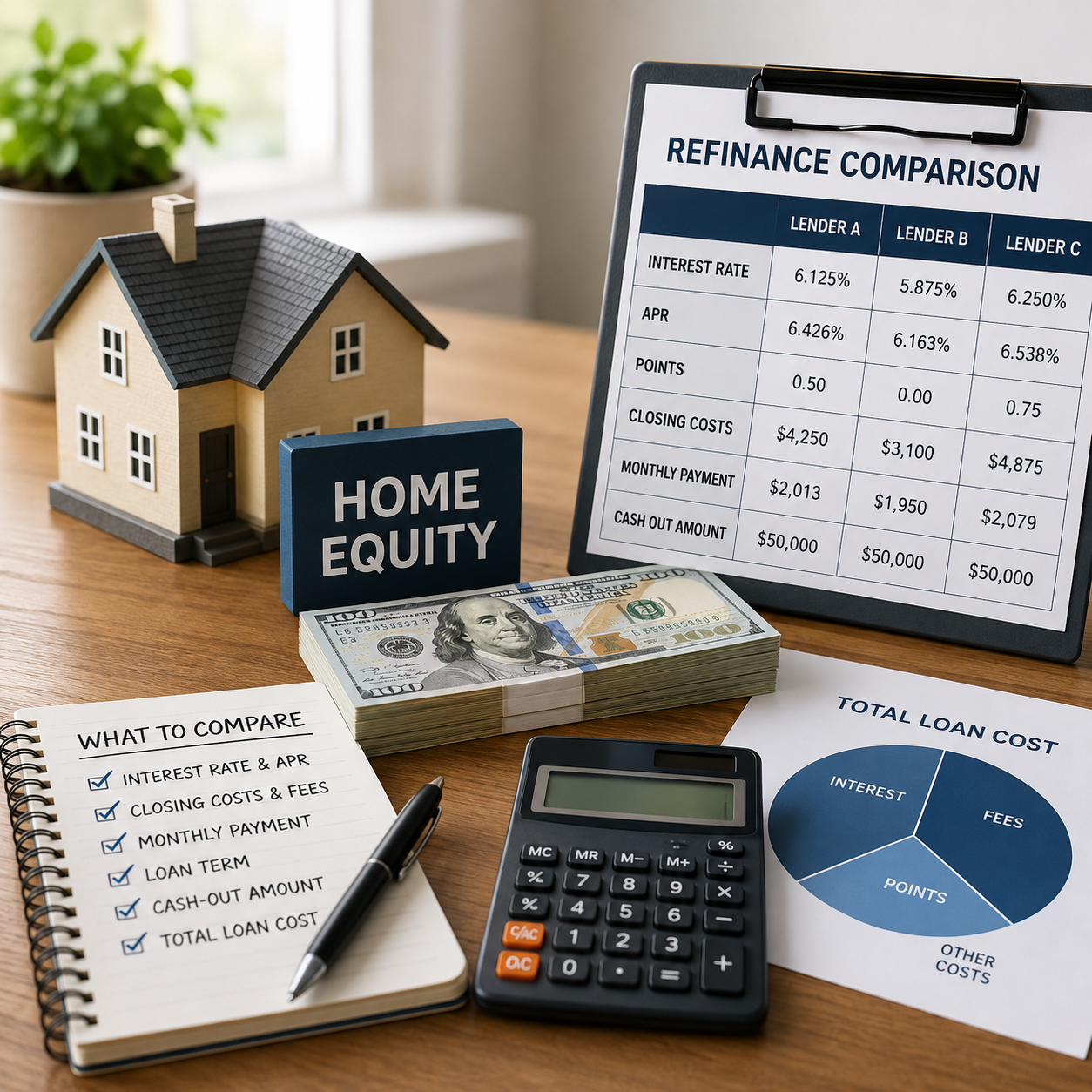
Cash-Out Refinance Rates matter because the rate is only one part of using home equity through a new mortgage. A lower-looking payment can still carry higher long-term cost if the loan balance grows, the term resets, or fees are added.
Educational note: USRefiRates.com provides general mortgage refinancing education only and does not provide financial, legal, or tax advice. We are not a lender, broker, loan marketplace, or approval service. Mortgage refinance rates, APRs, fees, loan terms, closing costs, approval requirements, and savings estimates vary by lender, borrower profile, credit score, property type, loan amount, location, and market conditions. Always review the lender’s official loan disclosures, closing documents, and full loan agreement carefully before accepting any refinance offer.
Quick Answer
Cash-out refinance rates are only one part of the total cost. Compare the interest rate, APR, closing costs, lender fees, loan term, monthly payment, and total amount borrowed before choosing an offer.
Current Cash-Out Refinance Rates
Recent U.S. cash-out refinance rate range: approximately 6.27%–6.91%.
Actual rates can vary by lender, credit score, home equity, loan amount, property type, location, points, fees, and market conditions. Rates can change frequently, so homeowners should compare current offers from multiple lenders.
Last checked: August 18, 2026
How to Compare Cash-Out Refinance Rates
Compare more than the interest rate. Check the APR, points, lender fees, closing costs, loan term, monthly payment, and total amount borrowed. Ask different lenders for the same type of loan so the offers are easier to compare. Paying points may reduce the interest rate but increase upfront costs.
When comparing cash out refinance rates, use the same requested cash-out amount and loan term across lenders so differences in rate, APR, points, fees, closing costs, and monthly payment are easier to judge.
Compare the full cost, not just the rate. Check the APR, fees, closing costs, loan term, new loan balance, and monthly payment. Start with this simple guide: cash-out refinance.
What Cash-Out Refinance Rates Mean
Cash-Out Refinance Rates usually refer to the interest rate offered on a new mortgage that replaces an existing home loan and provides cash back from available equity. The homeowner is often replacing the main mortgage with a larger loan.
A cash-out refinance may be used for debt consolidation, home repairs, emergency reserves, or another major financial need. Requirements vary by lender, loan type, borrower profile, and property.
Why Homeowners Compare Cash-Out Refinance Rates
Homeowners compare Cash-Out Refinance Rates because the cost of borrowing against a home can be very different from one lender to another. Mortgage rates, lender fees, approval requirements, and available programs can vary.
The right refinance choice depends on existing loan terms, equity, credit profile, fees, repayment goals, and how long the homeowner expects to keep the loan.
How This Refinance Option May Work
With a cash-out refinance, the lender may review the property value, existing mortgage balance, borrower income, credit history, debt obligations, and payment history. If approved, the new mortgage pays off the old mortgage. The remaining approved cash amount, after costs and payoffs, may be provided to the borrower.
Cash-Out Refinance Rates may be fixed or adjustable. A fixed-rate loan keeps the rate the same for the loan term. An adjustable-rate mortgage may start with one rate structure and later adjust under the loan terms.
Common Reasons Homeowners Consider Cash-Out Refinancing
Some homeowners consider cash-out refinancing when they want one larger mortgage instead of several smaller debts. Others use it to fund home improvements, handle major expenses, or create a more organized repayment plan.
This does not mean the choice is automatically safer. Accessing home equity increases the mortgage balance and can extend repayment risk.
How Lenders May Compare Borrowers
Lenders may review several borrower and property factors before offering cash-out refinance rates. These may include credit profile, income, debt-to-income considerations, home equity, property value, loan purpose, requested cash amount, and payment history.
Approval requirements are not the same everywhere. Homeowners can compare lender explanations and ask what documents are needed before submitting a full application.
Interest, APR, Points, Fees, Escrow, and Total Cost
Cash-out refinance rates should not be judged by the interest rate alone. APR may reflect more of the borrowing cost because it can include certain loan charges. Points, lender fees, third-party charges, appraisal costs, title fees, escrow changes, and prepaid items may also affect the final cost.
A quote with a lower interest rate may not be better if the upfront cost is much higher. Closing costs rolled into the loan can also raise the balance and increase total repayment over time.
Homeowners can use a cash-out refinance calculator to organize estimated payment, balance, and cost comparisons.
When Cash Access Changes the Refinance Decision
Cash-out refinance rates should be reviewed differently from a refinance that only changes the existing mortgage structure. Some homeowners mainly want a different loan term, rate type, or payment setup without pulling money from home equity.
A cash-out refinance adds another layer because the new mortgage may be larger than the old one. Before using equity, homeowners should compare the added cash benefit against the larger balance, closing costs, and longer repayment risk.
Fixed-Rate vs Adjustable-Rate Options
A fixed-rate refinance may appeal to borrowers who want payment predictability. An adjustable-rate option may look attractive at first, but the borrower should understand when and how the rate can change.
Short-Term Payment Relief vs Long-Term Cost Risk
Some refinance offers may reduce monthly pressure by stretching repayment over a longer term. That can help cash flow, but it may also increase long-term interest cost.
A shorter loan term may raise the payment but reduce the time in debt. Cash-out refinance rates should be compared alongside loan length, not separately.
Loan Comparisons That Matter
A careful refinance comparison should look at interest rate vs APR, monthly payment vs total loan cost, closing costs paid upfront vs rolled into the loan, shorter loan term vs longer loan term, fixed-rate vs adjustable-rate mortgage, accessing home equity vs increasing mortgage balance, refinancing vs keeping the existing loan, and requesting quotes vs accepting the first offer.
The lowest-looking payment is not always the lowest-cost loan.
How to Compare Refinance Lenders Safely
When reviewing cash-out refinance lenders, ask each lender for the same type of quote. Homeowners can compare rate, APR, points, estimated closing costs, escrow treatment, loan term, cash-out amount, and whether costs are paid upfront or added to the loan.
If a quote is hard to understand, ask for a clearer breakdown before moving forward.
Common Refinance Mistakes to Avoid
Common mistakes include focusing only on the interest rate, ignoring APR, rolling costs into the loan without understanding the balance increase, taking more cash than needed, resetting the mortgage term without comparing total cost, and assuming all lender quotes are the same.
Home equity can be useful, but it is still borrowed money secured by the property.
Example Homeowner Refinance Scenarios
One homeowner may want to replace several high-payment obligations with one mortgage payment. The key question is whether the total debt cost, repayment timeline, and home-equity risk still make sense.
Another homeowner may want funds for repairs that protect the home. Comparing cash-out refinance rates against the project size, loan fees, and repayment timeline may help the homeowner decide whether using equity is reasonable.
A third homeowner may only want a lower mortgage payment. If no cash is needed, a rate-and-term refinance may deserve comparison first.
Refinancing vs Other Home Equity Choices
Cash-out refinancing is not the only way to access equity. A home equity loan or line of credit may also be considered.
For a focused comparison, the guide on HELOC vs cash-out refinance can help homeowners think through whether replacing the first mortgage or adding a separate equity product may fit better.
How to Prepare Before Requesting Quotes
Before asking for refinance quotes, homeowners can gather mortgage statements, property information, income documents, insurance information, tax details, and a clear estimate of the cash they want to access.
It also helps to write down the reason for refinancing. A clear purpose makes it easier to avoid borrowing more than needed.
Practical Next Steps
Start by reviewing the existing mortgage balance, loan term, payment, escrow setup, and payoff details. Then decide whether the goal is cash access, payment structure, loan-term change, or debt organization.
Request more than one quote. Compare cash-out refinance rates side by side with APR, fees, points, escrow treatment, closing costs, loan term, and total repayment risk.
FAQs
Are Cash-Out Refinance Rates the Only Cost to Compare?
No. The rate matters, but APR, points, lender fees, third-party costs, escrow changes, loan term, and total repayment cost also matter.
Can a Cash-Out Refinance Increase My Mortgage Balance?
Yes. Because the borrower receives equity as cash, the new mortgage balance may be higher than the previous loan balance.
Is a Lower Monthly Payment Always Better?
Not always. A lower payment may come from a longer term or rolled-in costs. That can increase long-term cost even if the monthly payment feels easier.
Should I Compare Rate-and-Term Refinancing First?
If cash is not needed, comparing a rate-and-term refinance may be sensible. It may help homeowners see whether changing the loan without using equity is a cleaner option.
What Should I Ask Lenders Before Applying?
Ask how the interest rate, APR, points, closing costs, escrow items, loan term, cash-out amount, and total loan balance are calculated.
Quick Answer: What Should Homeowners Compare First?
Homeowners comparing cash-out refinance rates should look beyond the interest rate. Compare the APR, closing costs, lender fees, loan term, cash-out amount, escrow changes, and total loan cost. For a broader starting guide, see cash-out refinance.
Final Takeaway
Cash-out refinance rates should be compared as part of the full refinance offer, not by the advertised rate alone. Homeowners should review APR, lender fees, closing costs, loan term, monthly payment, equity use, and total repayment cost before accepting an offer.
Helpful Resources
Consumer Financial Protection Bureau Mortgage Resources
Consumer Financial Protection Bureau Loan Estimate Guide
Federal Trade Commission Credit and Loan Guidance
Author Bio: USRefiRates Editorial Team
Copyright Notice
© 2026 – USRefiRates. All rights reserved.
This article about Cash-Out Refinance Rates is protected by copyright and may not be copied, scraped, spun, republished, or used for commercial purposes without prior written permission from USRefiRates. Brief quotations may be used with clear attribution and a link to the original article.
USRefiRates.com provides mortgage refinance, home loan, cash-out refinance, rate-and-term refinance, home equity, FHA loan, VA loan, closing cost, lender comparison, and related mortgage education for informational purposes only. Unauthorized reuse of this content, including AI rewriting, content spinning, bulk scraping, or republication on another website, is strictly prohibited.
Disclaimer
This article is for general educational purposes only. It is not financial, legal, tax, lending, accounting, real estate, or mortgage advice. Mortgage refinance rates, fees, terms, disclosures, escrow treatment, closing costs, approval requirements, and available loan options can vary by lender, borrower profile, property, and loan type. Homeowners should review official loan documents, compare written estimates carefully, and speak with qualified professionals before making mortgage decisions.
Thanks for your comment. A cash-out refinance may let a homeowner access equity, but it also increases the mortgage balance. It is safest to compare the new payment, closing costs, APR, loan term, and long-term interest cost before deciding. You may also find this helpful: cash-out refinance lenders.
Thanks for your comment. A cash-out refinance may let a homeowner access equity, but it also increases the mortgage balance. It is safest to compare the new payment, closing costs, APR, loan term, and long-term interest cost before deciding. You may also find this helpful: cash-out refinance lenders.