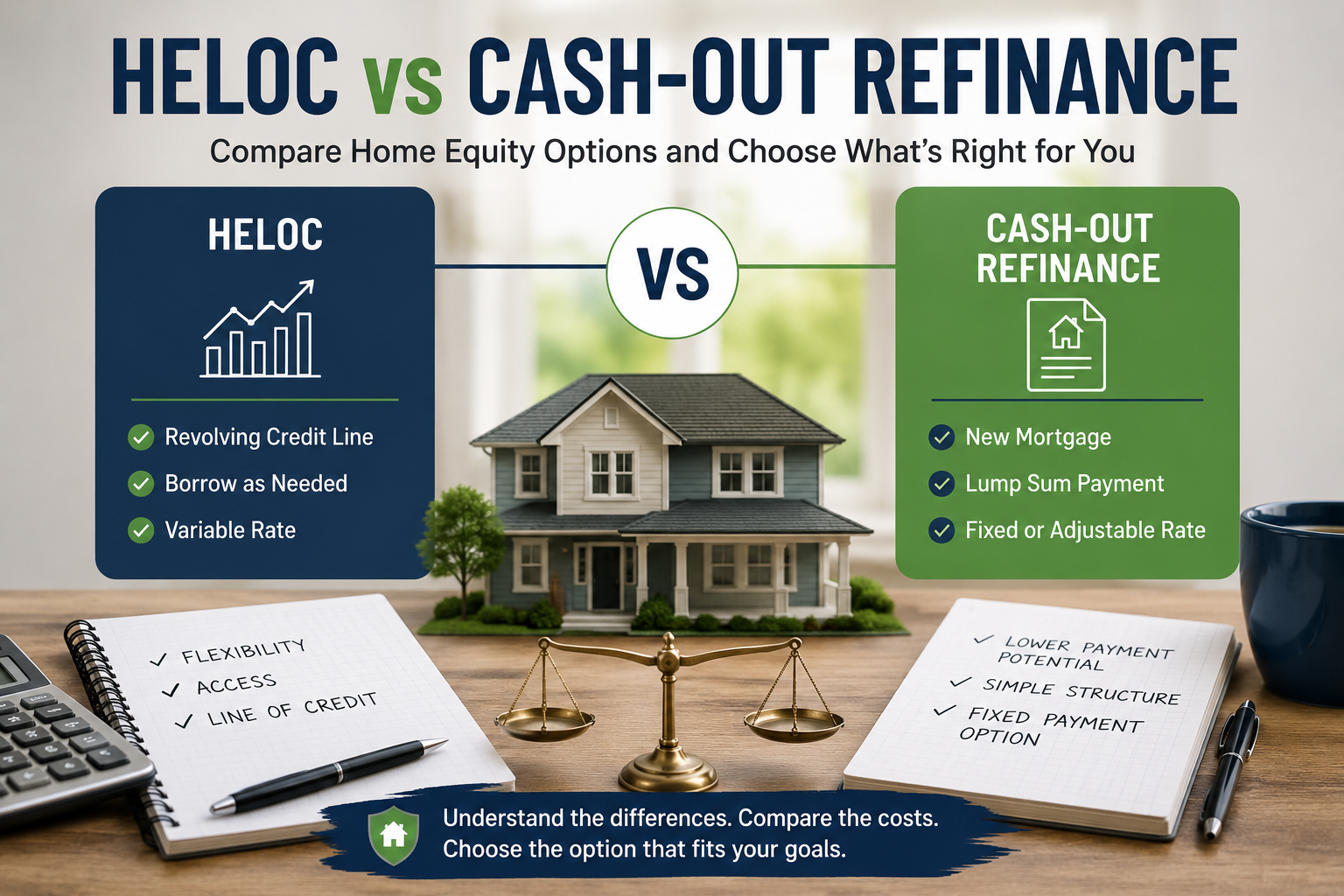
HELOC vs Cash-Out Refinance is a practical comparison for homeowners who want to use home equity without rushing into the wrong loan structure. Both options may provide access to equity, but they work differently. A HELOC may add a separate credit line secured by the home. A cash-out refinance may replace the current mortgage with a new, larger mortgage. The better first comparison depends on current loan terms, equity, credit profile, fees, repayment goals, and long-term risk.
Educational note: USRefiRates.com provides general mortgage refinancing education only and does not provide financial, legal, or tax advice. We are not a lender, broker, loan marketplace, or approval service. Mortgage refinance rates, APRs, fees, loan terms, closing costs, approval requirements, and savings estimates vary by lender, borrower profile, credit score, property type, loan amount, location, and market conditions. Always review the lender’s official loan disclosures, closing documents, and full loan agreement carefully before accepting any refinance offer.
Related guide: Homeowners comparing home equity options can also review cash-out refinance before deciding whether a HELOC or full refinance structure makes more sense.
HELOC vs Cash-Out Refinance: Quick Comparison
| Compare | HELOC | Cash-Out Refinance |
|---|---|---|
| Loan structure | Separate credit line secured by the home | Replaces the existing mortgage with a larger mortgage |
| Access to money | Borrow as needed, subject to lender terms | Usually receive approved cash after closing |
| Current mortgage | Usually remains in place | Replaced by the new mortgage |
| Rate structure | Often variable, depending on lender terms | May be fixed or adjustable |
| Closing costs | Vary by lender and product | May include refinance closing costs and lender fees |
| Best suited to | Homeowners wanting flexible access to equity | Homeowners wanting to refinance the main mortgage and access equity together |
| Main consideration | Adds another debt secured by the home | Changes the main mortgage and may increase the loan balance |
What HELOC vs Cash-Out Refinance Means
HELOC vs Cash-Out Refinance compares two ways homeowners may borrow against home equity. A home equity line of credit is usually a separate revolving line. Depending on the lender’s terms, the homeowner may borrow, repay, and borrow again during an available draw period.
A cash-out refinance generally replaces the existing mortgage with a new mortgage that is larger than the amount needed to pay off the old loan. The homeowner may receive part of the difference as cash after eligible payoff amounts and costs. For a broader starting point, see cash-out refinance.
The simple difference is this: a HELOC may sit beside the current mortgage, while a cash-out refinance may change the main mortgage itself.
Why Homeowners Compare These Options
Homeowners often compare HELOC vs Cash-Out Refinance for home repairs, renovations, debt consolidation, emergency reserves, or other large expenses. The decision is not only about getting cash. It is about what happens after the money is borrowed.
A homeowner who likes the current mortgage may not want to replace it. Another homeowner may prefer one new loan instead of a mortgage plus a separate credit line. Some borrowers want predictable payments. Others want flexible access because they do not need all funds at once.
The safer question is not “Which option sounds easier?” It is “Which option creates the most manageable total cost and repayment plan?”
How Each Option May Work
With a HELOC, lenders may review the property, borrower profile, income, credit history, payment history, existing mortgage balance, and available equity. The line may include variable-rate features, draw rules, repayment terms, fees, and borrowing limits.
With a cash-out refinance, the review may cover many of the same factors, but the result can affect the whole mortgage. The borrower may receive a new rate, APR, loan term, closing cost structure, and escrow setup. Homeowners comparing cash-out refinance rates should look beyond the rate and review APR, points, lender fees, and total loan cost.
That is why HELOC vs Cash-Out Refinance is a structure decision first and a rate decision second.
Cost Checks Before Choosing HELOC vs Cash-Out Refinance
Homeowners should compare interest, APR, points, lender fees, third-party closing costs, escrow changes, payment structure, and total repayment cost. APR can help show more of the borrowing cost than the interest rate alone, but it still should be read with the loan estimate and closing disclosure.
Rolling costs into the loan may reduce cash needed at closing, but it can increase the amount being repaid. A lower short-term payment may not mean a lower long-term cost. A longer loan term may feel easier month to month, but it may increase interest exposure over time.
Before requesting quotes, a homeowner can use a cash-out refinance calculator to organize rough numbers. Final decisions should still be based on current lender documents.
Fixed-Rate, Adjustable-Rate, and Term Choices
HELOC vs Cash-Out Refinance can involve fixed-rate and adjustable-rate choices. A fixed-rate option may feel easier to understand because the payment structure may be more predictable. An adjustable-rate option may create more uncertainty if the payment can change.
Loan term also matters. A shorter term may reduce long-term interest exposure but may create a higher required payment. A longer term may lower the scheduled payment but may increase total interest risk.
Homeowners should also compare rate-and-term refinance versus cash-out refinance. A rate-and-term refinance generally focuses on changing the existing mortgage terms without taking extra cash from equity. A cash-out refinance adds the equity-access question, which can increase the mortgage balance.
Borrower Factors Lenders May Review
For HELOC vs Cash-Out Refinance, lenders may review credit profile, income, debt-to-income position, home equity, property value, payment history, loan purpose, and current mortgage details. Requirements vary by lender, loan type, borrower profile, and property.
Home equity matters because the home secures the borrowing. Borrowing too much can reduce future flexibility. If income, expenses, or property plans change, a larger mortgage balance or separate credit line may feel harder to manage.
Borrower habits matter too. A revolving line can be useful for staged expenses, but it may tempt some homeowners to borrow more than planned. A cash-out refinance may be simpler to track, but it can also create a larger mortgage balance.
Example Homeowner Scenarios
One homeowner likes the current mortgage and needs funds gradually for repairs. That homeowner may compare a HELOC first because it may preserve the existing mortgage while offering flexible access, depending on approval and terms.
Another homeowner wants to replace the current mortgage and access equity at the same time. That borrower may compare a cash-out refinance first because one new loan may be easier to manage than two separate obligations.
A third homeowner is considering debt consolidation. HELOC vs Cash-Out Refinance should be reviewed carefully because moving unsecured debt into debt secured by the home can increase the stakes. A lower-looking payment can still create long-term risk.
How to Compare Refinance Lenders Safely
When comparing HELOC vs Cash-Out Refinance quotes, do not judge the offer by one number. A low-looking rate can still come with costs, trade-offs, or loan terms that change the real value of the refinance.
Ask each lender for clear written details showing the interest rate, APR, loan term, upfront charges, escrow treatment, points, required fees, and whether any costs are being added to the loan balance. Then compare each offer using the same loan amount, same term length, and same goal.
For homeowners reviewing cash-out refinance lenders, the strongest offer is usually the one that is easiest to understand, easiest to compare, and realistic for the household budget.
Common Mistakes to Avoid
HELOC vs Cash-Out Refinance can go wrong when homeowners focus only on access to cash. Common mistakes include ignoring APR, skipping fee review, overlooking closing costs, choosing a longer loan term without understanding total interest risk, and treating home equity like free money.
Another mistake is comparing quotes too loosely. A small difference in fees, points, term length, or rate type can change the real cost. Homeowners should also avoid borrowing more than they can comfortably repay.
Practical Next Steps Before Applying
Before applying, homeowners can list the current mortgage balance, estimated home value, monthly budget, credit obligations, reason for borrowing, preferred repayment speed, and how long they expect to keep the home or loan.
Then compare HELOC vs Cash-Out Refinance with three questions:
- Will this option preserve the current mortgage or replace it?
- What is the full cost after APR, fees, points, escrow, and term length?
- What repayment risk does this create if income, expenses, or home plans change?
Those answers can make lender conversations clearer and less stressful.
FAQs
Is HELOC vs Cash-Out Refinance mainly about the interest rate?
No. The interest rate matters, but APR, points, lender fees, closing costs, loan term, rate type, escrow, and total repayment cost also matter.
Which option is better for home improvements?
It depends on the project, timing, budget, and repayment plan. A HELOC may suit staged expenses for some homeowners. A cash-out refinance may suit others who prefer one new mortgage structure.
Can a cash-out refinance increase risk?
Yes. A cash-out refinance may increase the mortgage balance and repayment responsibility. Because the loan is secured by the home, homeowners should review total cost before using equity.
Can a HELOC affect the home?
Yes. A HELOC is generally secured by the property. Homeowners should understand the credit line terms, repayment rules, fees, and rate structure before borrowing.
What should homeowners compare first?
First compare whether the current mortgage should be preserved or replaced. Then compare total cost, payment stability, fees, APR, equity use, and repayment risk.
HELOC vs Cash-Out Refinance FAQs
Is HELOC vs Cash-Out Refinance mainly about the interest rate?
No. The interest rate matters, but homeowners should also compare APR, points, lender fees, closing costs, loan term, rate type, repayment structure, equity risk, and total repayment cost.
Which option is better for home improvements?
It depends on the project, timing, budget, and repayment plan. A HELOC may suit staged expenses for some homeowners. A cash-out refinance may suit others who prefer one new mortgage structure.
Can a cash-out refinance increase risk?
Yes. A cash-out refinance may increase the mortgage balance and repayment responsibility. Because the loan is secured by the home, homeowners should review total cost before using equity.
Can a HELOC affect the home?
Yes. A HELOC is generally secured by the property. Homeowners should understand the credit line terms, repayment rules, fees, and rate structure before borrowing.
When may HELOC vs Cash-Out Refinance matter most?
HELOC vs Cash-Out Refinance may matter most when a homeowner wants to use home equity but is unsure whether to keep the current mortgage or replace it with a new loan. The right comparison depends on the borrower’s goals, current mortgage, budget, and repayment comfort.
Can HELOC vs Cash-Out Refinance affect long-term cost?
Yes. A HELOC may add a separate payment, while a cash-out refinance may increase the mortgage balance or change the loan term. Either option can affect long-term borrowing costs.
What should homeowners compare before choosing?
Homeowners should compare total loan cost, monthly payment risk, rate type, APR, points, lender fees, closing costs, escrow changes, and how much home equity will remain after borrowing.
Is one option always better?
No. HELOC vs Cash-Out Refinance depends on the homeowner. One borrower may prefer flexible access to equity. Another may prefer one new mortgage. The safer choice is the one that fits the full repayment picture, not just the cash amount.
Final Takeaway
HELOC vs Cash-Out Refinance comes down to how the homeowner wants to access equity, repay the debt, and manage interest costs. Compare rates, APR, fees, loan terms, monthly payments, equity risk, and total repayment cost before choosing either option.
Helpful Resources
Consumer Financial Protection Bureau Mortgage Resources
Consumer Financial Protection Bureau Loan Estimate Guide
Federal Trade Commission Credit and Loan Guidance
U.S. Department of Housing and Urban Development Housing Resources
Copyright Notice
© 2026 – USRefiRates. All rights reserved.
This HELOC vs Cash-Out Refinance guide is original educational content published by USRefiRates and may not be copied, rewritten, scraped, spun, sold, or republished without written permission. Short quoted excerpts are allowed only when proper credit and a link to the original page are included.
USRefiRates.com publishes mortgage refinance, home equity, cash-out refinance, rate-and-term refinance, closing cost, loan comparison, and homeowner borrowing education for informational use. Unauthorized reuse, bulk extraction, AI rewriting, or republication of this material is not permitted.
Disclaimer
This article is for general education only. It is not financial, legal, tax, accounting, lending, real estate, or mortgage advice. Refinance costs, lender rules, approval factors, escrow handling, loan terms, and home equity options vary by borrower, property, loan type, and lender. Homeowners should review current lender documents before making a mortgage or refinance decision.
Thanks for your comment. A cash-out refinance may let a homeowner access equity, but it also increases the mortgage balance. It is safest to compare the new payment, closing costs, APR, loan term, and long-term interest cost before deciding. You may also find this helpful: cash-out refinance lenders.