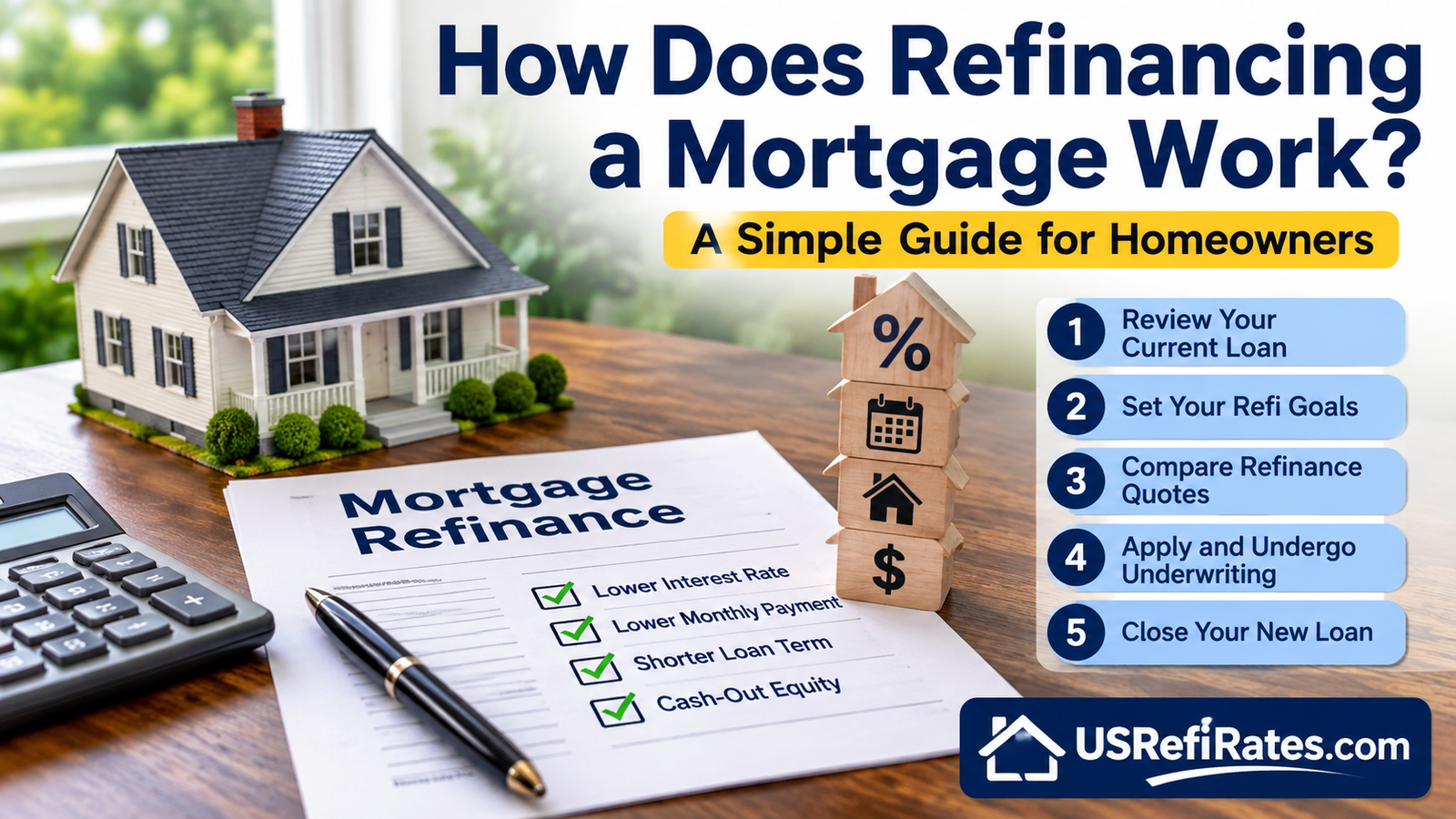
How does refinancing a mortgage work? In simple terms, a homeowner takes out a new mortgage that pays off and replaces the existing home loan. After closing, the homeowner repays the new mortgage under its new interest rate, term, payment structure, fees, and other conditions.
The process can look straightforward from the outside, but a refinance is a new mortgage transaction rather than a simple adjustment to the old loan. A homeowner may need to apply, document income and debts, have the property reviewed, compare lender disclosures, decide whether to lock the rate, and complete a new closing. The value of the refinance depends on how the complete new loan compares with the mortgage being replaced.
Educational note: USRefiRates.com provides general mortgage refinancing education only and does not provide financial, legal, or tax advice. We are not a lender, broker, loan marketplace, or approval service. Mortgage rates, APRs, fees, loan terms, closing costs, approval requirements, and available refinance options vary by lender, borrower profile, credit score, property type, loan amount, location, loan program, and market conditions. Always review the lender’s official disclosures, closing documents, and loan agreement before accepting a refinance offer.
How Does Refinancing a Mortgage Work? Quick Answer
How does refinancing a mortgage work from beginning to end? The homeowner first reviews the current mortgage and decides what they want to change. They then request refinance offers, submit a mortgage application, provide financial and property information, and allow the lender to complete underwriting. If the loan is approved and the homeowner accepts the final terms, the new mortgage closes and the existing mortgage is paid off.
A typical refinance comparison may involve:
- Existing mortgage balance
- Current interest rate
- Remaining loan term
- New loan amount
- New interest rate
- APR
- Monthly principal-and-interest payment
- Fixed or adjustable rate structure
- Discount points
- Lender credits
- Lender fees
- Third-party closing costs
- Escrow and prepaid items
- Cash needed to close
- Costs financed into the loan
- Rate-lock status
- Home equity after refinancing
The goal is not simply to get a new mortgage. The goal is to understand whether replacing the old mortgage with the proposed new one actually supports the homeowner’s reason for refinancing.
Homeowners who want the basic definition first can review what is mortgage refinancing.
How Does Refinancing a Mortgage Work Step by Step?
The exact process varies by lender and loan program, but the major stages are usually similar.
Step 1: Review the Existing Mortgage
Start with the loan that is already in place.
Useful information can include:
- Current mortgage balance
- Approximate payoff amount
- Current interest rate
- Remaining loan term
- Monthly principal-and-interest payment
- Fixed or adjustable structure
- Escrow arrangement
- Mortgage insurance, if applicable
This creates the baseline for the refinance comparison. Without understanding the existing mortgage, it is difficult to judge whether a new offer represents a meaningful improvement or simply a different structure.
Step 2: Define the Refinance Goal
Before requesting lender quotes, identify the main reason for refinancing.
A homeowner may want to:
- Change the interest-rate structure
- Move from an adjustable-rate mortgage to a fixed-rate mortgage
- Change the loan term
- Reduce monthly payment pressure
- Restructure the mortgage for a different repayment plan
- Access home equity through a cash-out refinance
How does refinancing a mortgage work best as a decision process? It starts with a clear goal. The homeowner can then judge each offer by whether it moves the mortgage toward that goal after costs and risks are included.
Step 3: Request Comparable Lender Offers
The homeowner can approach one or more lenders and request information about available refinance options.
For a useful comparison, try to request similar loan structures. Comparing a 30-year fixed-rate mortgage with a 15-year fixed-rate mortgage or an adjustable-rate loan can produce very different payments and costs because the products themselves are different.
Homeowners reviewing pricing can compare mortgage refinance rates, but an advertised rate should not be treated as a guaranteed personal offer.
Step 4: Apply and Provide Documentation
A refinance is a new mortgage application. The lender may ask for information about income, assets, debts, employment, insurance, the property, and the existing mortgage.
The lender may also obtain credit information and review the borrower’s ability to repay the proposed loan. Requirements vary by lender, borrower, property, and loan program.
This is an important part of the refinance process because a quote or advertised rate is not the same as final loan approval.
Step 5: Property Value and Home Equity May Be Reviewed
The lender may need to evaluate the property and the homeowner’s equity position. Depending on the loan and lender, this may involve an appraisal or another accepted valuation method.
Property value matters because it affects the relationship between the amount borrowed and the value of the home. That relationship can influence available refinance options and, in some cases, pricing or approval requirements.
A cash-out refinance may require especially careful attention to the new loan balance and the equity that remains after closing.
Step 6: Review the Loan Estimate
For covered consumer mortgage transactions, the Loan Estimate provides important estimated loan terms and costs after application. CFPB describes the Loan Estimate as a three-page form containing information including the estimated interest rate, payment and closing costs.
When asking how does refinancing a mortgage work in practical terms, this document is one of the most useful comparison tools.
Review items such as:
- Loan amount
- Interest rate
- APR
- Monthly principal and interest
- Loan term
- Points
- Lender credits
- Origination charges
- Estimated closing costs
- Estimated cash to close
- Taxes, insurance, and escrow information
- Prepayment penalty, if applicable
- Whether the interest rate is locked
A Loan Estimate is not the same as final approval. It is a disclosure that helps the borrower understand and compare the terms the lender expects to offer if the application proceeds.
Step 7: Decide Whether and When to Lock the Rate
Mortgage rates can change before closing unless the borrower has a valid rate lock covering the relevant period and the conditions of that lock continue to be met.
The homeowner should check whether the rate is locked, how long the lock lasts, what happens if closing is delayed, and what changes to the application could affect the terms.
CFPB notes that an unlocked mortgage rate can change, while a rate lock generally protects the rate through the stated period as long as the transaction closes within that period and relevant application details do not change.
This stage matters because the rate discussed early in the process may not necessarily be the rate available at closing if it was never locked.
Step 8: Underwriting and Final Conditions
The lender reviews the application and supporting information to decide whether the loan meets its requirements.
The lender may verify income, assets, debts, credit, property information, insurance, occupancy, and other details. Additional documentation or explanations may be requested before the lender reaches a final decision.
How does refinancing a mortgage work during underwriting? The lender is testing whether the borrower and property satisfy the requirements for the specific refinance being requested. This is why an early quote should not be confused with a completed approval.
Step 9: Review the Closing Disclosure
Before closing on many consumer mortgage transactions, the borrower receives a Closing Disclosure with final details about the loan, including the loan terms, projected payments, and closing costs.
CFPB states that for covered mortgages the lender must provide the Closing Disclosure at least three business days before closing, giving the borrower time to compare the final terms with the earlier Loan Estimate.
Compare it with the earlier Loan Estimate. If important numbers have changed, ask the lender why.
Pay particular attention to:
- Loan amount
- Interest rate
- Monthly payment
- Closing costs
- Cash to close
- Points and lender credits
- Prepaid items
- Escrow
- Loan features
Step 10: Close the New Mortgage
If the homeowner accepts the final loan terms and completes closing, the refinance proceeds. The new mortgage is used to satisfy the existing mortgage, and the homeowner begins repayment under the new agreement.
That is the central answer to how does refinancing a mortgage work: the old mortgage obligation is replaced by a new mortgage obligation with a new set of terms and costs.
What Changes After a Mortgage Refinance?
A successful refinance can change several parts of the homeowner’s mortgage situation at once.
The new mortgage may have a different:
- Interest rate
- APR
- Loan balance
- Loan term
- Monthly payment
- Fixed or adjustable rate structure
- Escrow arrangement
- Lender
- Closing-cost treatment
- Home-equity position
The existing mortgage does not continue alongside a standard first-mortgage refinance. The replacement loan pays it off. The borrower then follows the repayment schedule of the new mortgage.
How does refinancing a mortgage work financially after closing? That depends on what changed. A lower payment may come from a lower rate, a longer term, a different balance, or several factors together. The homeowner should understand the source of the change rather than assuming the new payment tells the entire story.
Rate-and-Term Refinance vs Cash-Out Refinance
Two broad refinance purposes are often discussed separately.
Rate-and-Term Refinance
A rate-and-term refinance generally replaces the existing mortgage to change the interest rate, loan term, loan structure, or a combination of these without primarily using the transaction to withdraw additional home equity as cash.
A homeowner may use this type of refinance to move from an adjustable rate to a fixed rate, change the repayment period, or restructure the mortgage for another reason.
Cash-Out Refinance
A cash-out refinance replaces the existing mortgage with a larger new mortgage and allows the homeowner to receive part of the available equity as cash, subject to lender requirements.
Before using equity, review the cash out refinance guide carefully.
How does refinancing a mortgage work differently with cash out? The new loan balance is larger because the transaction is doing more than simply replacing the amount currently owed. That can affect the payment, remaining equity, closing costs, and repayment risk.
Fixed-Rate vs Adjustable-Rate Refinance
A fixed-rate mortgage keeps its stated interest rate unchanged for the loan term. The principal-and-interest portion of the payment is therefore more predictable, although taxes, insurance, or other escrow-related amounts may still change.
An adjustable-rate mortgage can change according to the loan contract. The homeowner should understand the initial period, adjustment schedule, index, margin, caps, and potential future payment changes. Loan Estimates specifically disclose whether an interest rate can change after closing.
When evaluating how does refinancing a mortgage work under these two structures, the starting rate is only one factor. Payment stability, expected time in the home, future adjustment risk, and overall loan cost also matter.
Interest Rate, APR, Points, and Lender Credits
The interest rate affects the cost of borrowing and the principal-and-interest payment. APR provides a broader annualized measure because certain costs associated with obtaining the loan are included.
Discount points generally involve paying more upfront in exchange for a lower interest rate. Lender credits can reduce some upfront closing costs in exchange for different loan pricing, commonly including a higher rate.
How does refinancing a mortgage work when lenders quote different combinations of these numbers? Compare the complete package rather than one figure.
A lower rate may require more points. A higher rate may come with lender credits. Two similar rates can have different lender fees. The homeowner should compare the rate, APR, points, lender credits, loan term, and cash needed at closing together.
Refinance Closing Costs
A refinance can involve lender charges and third-party costs.
Depending on the loan, these may include:
- Origination charges
- Appraisal-related costs
- Title services
- Settlement services
- Recording charges
- Prepaid interest
- Escrow funding
- Other required services or charges
For a detailed breakdown, review refinance closing costs.
Some costs may be paid from the homeowner’s funds at closing. Depending on the loan structure, some eligible costs may be financed into the new mortgage or offset through lender credits. CFPB notes that so-called “no-closing-cost” structures can involve a higher interest rate with lender credits or adding costs to the loan balance.
How does refinancing a mortgage work when costs are financed? The immediate cash requirement can fall, but the loan balance may increase. The homeowner should consider both the cash needed today and the effect on future repayment.
Escrow and Prepaid Items
A refinance can affect escrow because the old mortgage is being paid off and a new loan is being created.
The new closing may include prepaid interest, property-tax amounts, homeowners-insurance amounts, or funds needed to establish a new escrow account when applicable. Mortgage closing costs and prepaid expenses can include items such as appraisal charges, title-related expenses, taxes, insurance and interest.
These amounts should not automatically be treated as though they are all lender fees. Review the Loan Estimate and Closing Disclosure to understand what each major amount represents.
How does refinancing a mortgage work when the old escrow account still has money in it? The handling of the previous escrow balance and the funding of the new account may occur separately, so homeowners should ask the servicer and lender how the timing will work for their transaction.
Shorter Loan Term vs Longer Loan Term
Changing the term can have a major effect on both the payment and the scheduled payoff date.
A shorter term may create a higher monthly payment but a faster repayment path. A longer term may reduce monthly payment pressure but extend the period the mortgage remains outstanding.
Suppose a homeowner has already paid down a 30-year mortgage for many years. Replacing it with a new 30-year loan can restart a much longer repayment schedule.
How does refinancing a mortgage work in that situation? The payment may fall even if the long-term borrowing path becomes longer. CFPB specifically warns borrowers to understand whether a lower payment comes from a lower rate or from stretching repayment over a longer term.
The homeowner should compare the remaining term on the old loan with the full term of the proposed refinance.
Monthly Payment vs Total Borrowing Cost
A lower monthly payment can be valuable for household cash flow, but it does not automatically mean the refinance is cheaper overall.
The payment can change because of:
- Interest rate
- Loan term
- New loan balance
- Costs financed into the loan
- Mortgage insurance
- Escrow changes
A strong refinance comparison therefore looks at more than the monthly amount due.
Homeowners should compare the existing balance and remaining term with the new balance, new term, closing costs, and expected time in the replacement mortgage.
That broader view is a more useful answer to how does refinancing a mortgage work than simply asking whether the new monthly payment is lower.
Break-Even Thinking
Some homeowners estimate how long it may take for expected monthly savings to recover upfront refinance costs.
A simple starting calculation is:
refinance costs ÷ expected monthly savings = approximate break-even period
This is a planning tool, not a guarantee.
If the refinance changes the loan term substantially, increases the balance, or involves points, the homeowner should look beyond the simple break-even calculation and consider the broader cost of the replacement mortgage.
How does refinancing a mortgage work for someone who may move soon? Upfront costs deserve particular attention because the homeowner may not keep the new loan long enough to reach the estimated break-even point.
What Lenders May Review
A refinance application may involve a review of factors such as:
- Credit history
- Credit score
- Income
- Assets
- Existing debts
- Debt-to-income position
- Mortgage payment history
- Property value
- Home equity
- Occupancy
- Loan purpose
- Requested loan amount
- Documentation
Requirements vary by lender and loan program.
How does refinancing a mortgage work from the lender’s side? The lender is evaluating whether the borrower, property, and proposed loan meet the requirements for the mortgage being requested.
No single factor tells the entire story, which is one reason lender offers can differ.
How to Compare Refinance Offers Side by Side
Homeowners can compare mortgage refinance quotes using the same categories across lenders.
| Compare | Existing Mortgage | Lender A | Lender B |
|---|---|---|---|
| Loan balance | Current | Proposed | Proposed |
| Interest rate | Current | Quoted | Quoted |
| APR | Current/available | Quoted | Quoted |
| Loan term | Remaining | Proposed | Proposed |
| Rate structure | Fixed/adjustable | Fixed/adjustable | Fixed/adjustable |
| Principal & interest payment | Current | Estimated | Estimated |
| Points | — | Quoted | Quoted |
| Lender credits | — | Quoted | Quoted |
| Lender fees | — | Estimated | Estimated |
| Other closing costs | — | Estimated | Estimated |
| Cash to close | — | Estimated | Estimated |
| Costs financed | — | Estimated | Estimated |
| Rate locked? | — | Yes/No | Yes/No |
| Cash-out amount | — | If applicable | If applicable |
How does refinancing a mortgage work as a comparison exercise? The table helps prevent one attractive number from dominating the decision. The proposed refinance needs to be judged as a complete loan.
Common Refinance Mistakes
Focusing Only on the Interest Rate
A lower rate may involve points or other costs that affect the value of the offer.
Looking Only at the Monthly Payment
A lower payment may come from extending the repayment term.
Ignoring APR
APR can provide additional context about certain costs associated with obtaining the mortgage.
Ignoring Closing Costs
Refinancing has transaction costs that should be considered against the expected benefit.
Treating a Quote as Final Approval
An advertised rate, preliminary quote, and Loan Estimate are not the same as completed underwriting and final closing terms.
Forgetting About the Rate Lock
An unlocked rate can change before closing.
Rolling Costs Into the Loan Without Reviewing the New Balance
Financing costs can reduce cash needed at closing while increasing the amount borrowed.
Using Home Equity Without Understanding the New Debt
Cash-out refinancing converts part of the homeowner’s equity into additional mortgage debt secured by the home.
These mistakes help explain why homeowners should use a full-process comparison rather than a rate-only comparison.
Simple Homeowner Refinance Examples
Example 1: Moving to a Fixed Rate
A homeowner with an adjustable-rate mortgage wants more predictable principal-and-interest payments.
The homeowner compares fixed-rate refinance offers, including the rate, APR, closing costs, loan term, and payment. The decision is based on the entire replacement loan rather than the starting rate alone.
Example 2: Choosing a Shorter Term
Another homeowner wants a faster mortgage payoff path.
The shorter-term refinance may require a higher monthly payment. The homeowner compares that payment with the expected interest and repayment timeline and decides whether the household budget can support the new obligation.
Example 3: Lowering the Monthly Payment
A homeowner is primarily concerned about monthly cash flow.
A refinance offer provides a lower payment, but the new mortgage has a longer term. The homeowner compares the immediate monthly benefit with the longer repayment schedule and transaction costs.
Example 4: Accessing Home Equity
A homeowner considers taking cash out for a major planned expense.
How does refinancing a mortgage work in this example? The existing mortgage is replaced with a larger loan, and part of the difference is received as cash. The homeowner should examine the new balance, remaining equity, closing costs, payment, and repayment risk before proceeding.
How to Prepare Before Requesting Refinance Quotes
Preparation can make lender comparisons easier.
Gather information such as:
- Current mortgage statement
- Approximate payoff amount
- Current interest rate
- Remaining loan term
- Current payment
- Property information
- Approximate property value
- Income documentation
- Asset information
- Existing debts
- Homeowners-insurance information
- Refinance objective
- Desired loan amount
- Desired cash-out amount, if applicable
Then ask lenders to quote similar loan structures where practical. CFPB recommends comparing the same type of loan when reviewing Loan Estimates so differences are easier to evaluate.
How does refinancing a mortgage work more smoothly when the homeowner prepares first? The lender receives clearer information, and the homeowner has a better baseline for comparing the new offers with the existing mortgage.
Practical Next Steps
Start with the existing mortgage and the reason for refinancing.
Then request written lender information and compare similar loan structures. Review the interest rate, APR, points, lender credits, loan term, closing costs, cash to close, financed costs, rate-lock status, and new mortgage balance.
Use the Loan Estimate to compare proposed terms and costs. If you proceed toward closing, compare the final Closing Disclosure with the earlier estimate and ask about significant changes or unclear charges.
How does refinancing a mortgage work as a final decision? The homeowner replaces the existing mortgage only after deciding that the new loan’s complete cost, repayment structure, and risk fit the intended goal.
FAQs About How Does Refinancing a Mortgage Work
How Does Refinancing a Mortgage Work in Simple Terms?
How does refinancing a mortgage work? A new mortgage is used to pay off and replace the existing mortgage. After closing, the homeowner repays the new loan under its new terms.
Is Refinancing the Same as Changing the Existing Mortgage?
Not usually. A standard refinance creates a new mortgage that replaces the existing one. A loan modification, by contrast, generally changes terms of an existing loan rather than replacing it with a new mortgage.
Does Refinancing Always Lower the Monthly Payment?
No. The payment depends on the new loan balance, interest rate, loan term, rate structure, mortgage insurance if applicable, and other factors. A shorter-term refinance may have a higher monthly payment even if the rate is lower.
Does Refinancing Always Save Money?
No. Closing costs, points, lender fees, the new term, the new loan balance, and how long the homeowner keeps the replacement mortgage can all affect the outcome.
Can Refinance Costs Be Added to the New Loan?
Some refinance structures may allow eligible costs to be financed into the new mortgage. This can reduce cash required at closing while increasing the loan balance. CFPB notes this as one possible structure behind advertised “no-closing-cost” refinancing.
Can the Mortgage Rate Change Before Closing?
Yes, if the rate has not been locked. Even with a rate lock, certain changes to the application can affect the terms depending on the lock agreement and lender policy.
What Documents Help Homeowners Compare a Refinance?
The Loan Estimate provides estimated loan terms and costs, while the Closing Disclosure provides final details for many consumer mortgage transactions before closing.
How Many Refinance Offers Should a Homeowner Compare?
There is no single number that suits every borrower. Comparing more than one similar written offer can make differences in rates, APR, points, lender credits, fees, and loan terms easier to see.
What Should Be Compared Before Refinancing?
Compare the existing mortgage with the proposed loan amount, interest rate, APR, term, monthly payment, points, lender credits, closing costs, cash to close, financed costs, rate-lock status, equity impact, and expected time in the new loan.
Final Takeaway
How does refinancing a mortgage work? The homeowner applies for a new mortgage, the lender reviews the borrower and property, the proposed terms and costs are disclosed, the homeowner decides whether to proceed, and—if the loan closes—the new mortgage pays off and replaces the existing one.
The most important part is not simply completing the refinance process. It is comparing the old mortgage and proposed new mortgage carefully enough to understand what is changing.
Interest rate, APR, loan term, monthly payment, points, lender credits, closing costs, cash to close, home equity, rate-lock status, and total borrowing path should all be considered together.
A refinance should make sense as a complete replacement loan before it becomes a signed obligation.
Helpful Resources
Consumer Financial Protection Bureau — Mortgage Resources Consumer Financial Protection Bureau — Loan Estimate Guide Consumer Financial Protection Bureau — Rate Lock Guidance Consumer Financial Protection Bureau — Closing Disclosure Guidance Fannie Mae — Homeownership and Mortgage Education Freddie Mac — Homebuyer and Homeowner Education
Copyright Notice
© 2026 – USRefiRates. All rights reserved.
This article about how does refinancing a mortgage work is protected by copyright and may not be copied, scraped, spun, republished, or used for commercial purposes without prior written permission from USRefiRates. Brief quotations may be used with clear attribution and a link to the original article.
USRefiRates.com provides mortgage refinance, home loan, cash-out refinance, rate-and-term refinance, home equity, FHA loan, VA loan, closing cost, lender comparison, and related mortgage education for informational purposes only. Unauthorized reuse of this content, including AI rewriting, content spinning, bulk scraping, or republication on another website, is strictly prohibited.
Disclaimer
This guide is provided for general homeowner education only. It is not financial, legal, tax, lending, accounting, real estate, or mortgage advice. Refinance rates, APRs, lender charges, loan terms, approval standards, closing costs, escrow treatment, and available refinance options can differ by lender, borrower, property, and loan type. Before making a refinance decision, homeowners should read the loan estimate, closing disclosure, and other official loan documents carefully and speak with qualified professionals when needed.