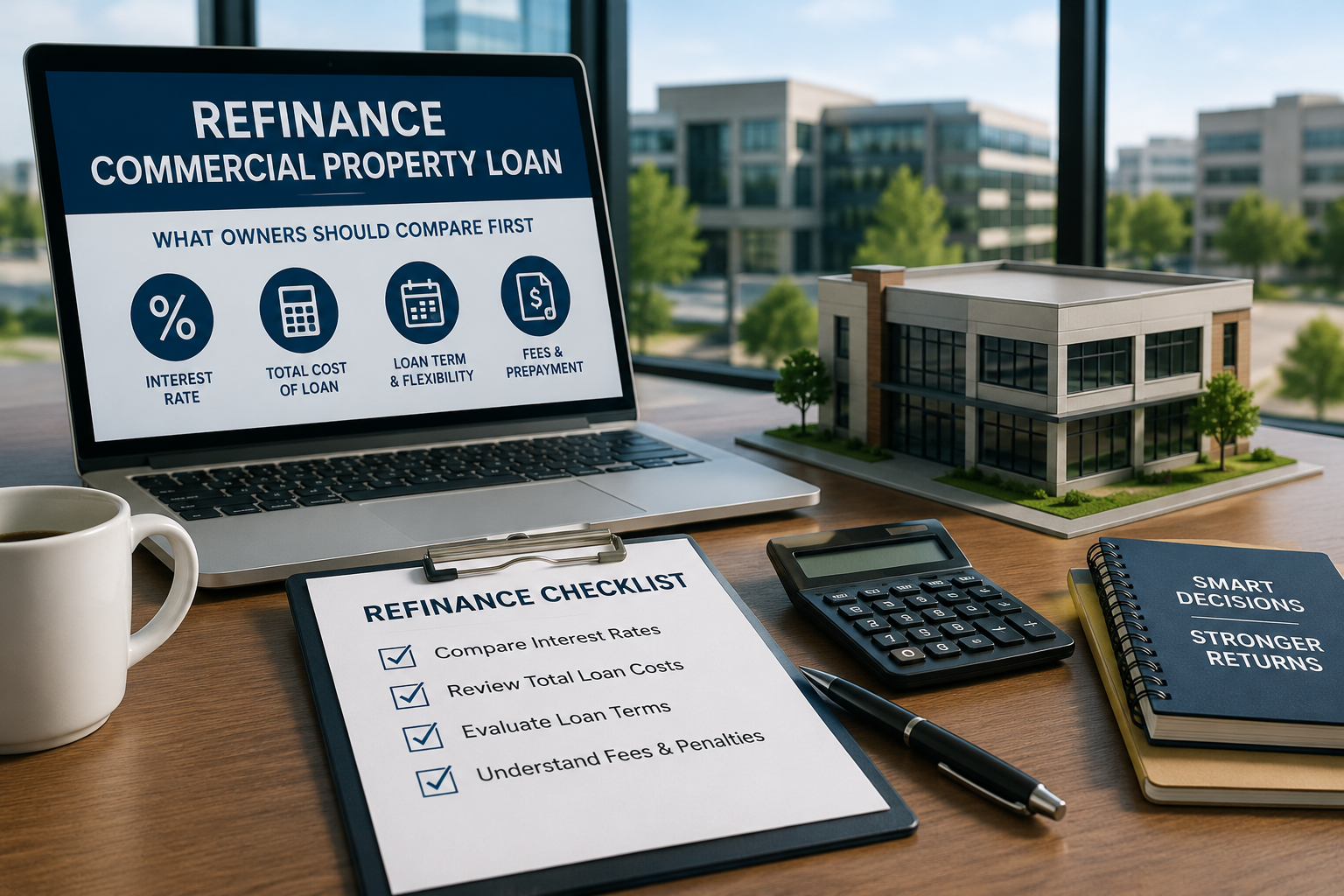
A refinance commercial property loan can help a property owner replace an existing mortgage with a new loan, but the real question is not simply whether refinancing is available. The smarter question is whether the new loan improves the owner’s position after fees, repayment terms, APR, closing costs, equity risk, and long-term borrowing cost are reviewed carefully.
For related USRefiRates.com guidance, compare current mortgage refinance rates, understand refinance closing costs, review how a cash-out refinance works, and use our mortgage refinance hub to explore the broader topic.
Educational note: USRefiRates.com provides general mortgage refinancing education only and does not provide financial, legal, or tax advice. We are not a lender, broker, loan marketplace, or approval service. Mortgage refinance rates, APRs, fees, loan terms, closing costs, approval requirements, and savings estimates vary by lender, borrower profile, credit score, property type, loan amount, location, and market conditions. Always review the lender’s official loan disclosures, closing documents, and full loan agreement carefully before accepting any refinance offer.
Commercial property refinancing can sound simple from the outside. New loan. New terms. Maybe a different payment. Done. Not quite. A refinance can change the cost structure of the property for years, so owners should slow down before chasing a lower payment or accepting a lender quote that looks attractive at first glance.
What a Refinance Commercial Property Loan Means
A refinance commercial property loan means an existing loan secured by a commercial property is paid off and replaced with a new loan. The new loan may come from the same lender or a different lender.
The property may be used for office space, retail space, mixed-use purposes, warehouse space, rental income, or another business-related property use. Lender rules can vary based on the property type, borrower profile, income history, property value, lease strength, and repayment risk.
This is different from small business financing, which may cover broader funding needs not always tied directly to a property mortgage. A refinance commercial property loan is mainly about the debt secured by the property itself.
Commercial Property Refinance vs Residential Mortgage Refinance
A commercial property refinance is generally based more heavily on the property’s income, cash flow, occupancy, leases, value, and ability to support the debt. Residential mortgage refinancing usually focuses more heavily on the individual borrower’s household income, credit profile, debts, and owner-occupied property.
Commercial loan structures, underwriting standards, repayment terms, fees, maturity dates, and lender documentation can also differ substantially from residential mortgage refinancing. Property owners should therefore compare commercial refinance offers using the specific written terms provided for the property and loan.
Why Owners Compare a Refinance Commercial Property Loan
Owners may compare a refinance commercial property loan when the current loan no longer fits their goals. The existing loan may have a payment structure, maturity date, rate type, or fee arrangement that deserves a fresh review.
Common reasons include:
- Comparing a fixed-rate option against an adjustable-rate option.
- Reviewing total loan cost before a balloon payment or maturity date.
- Replacing a loan with terms that feel too restrictive.
- Accessing equity through a cash-out refinance.
- Moving from short-term pressure toward a longer repayment structure.
- Comparing lender fees, APR, escrow, and closing costs.
The important part is comparison. Refinancing should not be treated as automatically better. The owner should compare the new loan against the current loan, not just against another lender advertisement.
How This Refinance May Work
With a refinance commercial property loan, the lender may review the property, borrower, current debt, income, leases, business use, and repayment history. The lender may also order an appraisal or property valuation, request income documents, review insurance, and assess the owner’s ability to repay.
The new loan may pay off the old loan at closing. After that, the borrower begins making payments under the new terms.
Some refinance offers may reduce short-term payment pressure but extend repayment. Others may shorten the loan term but increase monthly obligations. Some may offer access to equity but increase the loan balance. None of these choices should be judged by the monthly payment alone.
What Lenders May Compare
Lenders may compare several factors before approving a refinance commercial property loan. Requirements vary by lender, loan type, borrower profile, and property.
They may review:
- Credit profile and payment history.
- Business or property income.
- Debt-to-income or debt-service capacity.
- Property value and equity.
- Existing mortgage balance.
- Lease strength or occupancy.
- Cash reserves.
- Insurance and property condition.
- Prior delinquencies or repayment issues.
Commercial property lenders may also focus closely on debt-service coverage and loan-to-value. Debt-service coverage helps show whether property or business cash flow can support the loan payments, while loan-to-value compares the loan amount with the property’s value. The lender’s required levels can vary by property type, borrower strength, loan structure, and risk.
A clean payment history can help, but it does not guarantee approval. Strong property value may help, but it does not remove the need to compare fees and repayment terms.
Commercial Property Refinance: Quick Comparison
| Compare | Current Loan | New Refinance Offer |
|---|---|---|
| Interest rate | Current rate | Proposed rate |
| Loan balance | Existing payoff amount | New loan amount |
| Loan term | Remaining term | New repayment term |
| Rate structure | Fixed or adjustable | Fixed or adjustable |
| Monthly payment | Current payment | Proposed payment |
| Fees and closing costs | Usually already paid | New refinance costs |
| Maturity or balloon date | Existing date | New maturity structure |
| Cash-out | None unless already borrowed | May be available if offered |
| Total borrowing cost | Remaining cost | New estimated total cost |
Interest Rate, APR, Fees, and Closing Costs
The interest rate is only one part of a refinance commercial property loan. Some lenders may provide an APR or other cost measure, but commercial loan disclosures can differ from consumer mortgage disclosures. Owners should compare the interest rate, lender fees, closing costs, repayment structure, and total borrowing cost using the written terms provided by each lender.
Costs may include lender fees, origination charges, appraisal costs, title costs, recording costs, escrow requirements, legal review costs, points, or other closing expenses. The exact costs can vary.
This is where many owners make a costly mistake. A lower payment can look good, but if closing costs are high or the loan term is extended too far, the total borrowing cost may not improve.
Owners should compare:
- Interest rate versus APR.
- Monthly payment versus total loan cost.
- Upfront closing costs versus costs rolled into the loan.
- Shorter repayment term versus longer repayment term.
- Fixed-rate stability versus adjustable-rate uncertainty.
Fixed-Rate vs Adjustable-Rate Options
A fixed-rate refinance commercial property loan may offer more predictable payments. That can help owners who value stability and want fewer surprises.
An adjustable-rate option may start with different terms, but future payment changes can create risk. The owner should understand how and when the rate may adjust, what limits may apply, and how higher payments could affect cash flow.
Neither option is automatically best. The better choice depends on the owner’s repayment goals, property income, risk tolerance, loan term, and long-term plan for the property.
Rate-and-Term vs Cash-Out Refinance
A rate-and-term refinance mainly changes the loan terms without pulling substantial equity out of the property. Owners may use this to compare repayment structure, rate type, maturity date, or total loan cost.
A cash-out refinance increases the loan balance by allowing the owner to access some property equity. That cash may be useful, but it also increases debt secured by the property.
A refinance commercial property loan with cash-out should be reviewed carefully. Using equity can feel helpful, but it may add repayment pressure and reduce the owner’s margin for error.
This is not the same as business debt consolidation loans, where the main focus may be combining business debts. A property refinance should stay centered on the mortgage, lien, equity position, and property repayment risk.
Short-Term Relief vs Long-Term Cost Risk
Prepayment Penalties and Existing Loan Payoff Costs
Before refinancing a commercial property loan, owners should review the existing loan documents for any prepayment penalty, early payoff charge, or other cost triggered by refinancing before maturity.
These costs can reduce or even eliminate the financial benefit of moving to a new loan. The owner should request a current payoff statement and compare the full cost of leaving the existing loan with the fees, terms, and expected cost of the proposed refinance.
Prepayment rules vary by lender and loan structure, so the written loan agreement and payoff statement should control the comparison.
A refinance commercial property loan may reduce immediate payment strain, but that does not always mean the owner saves money. If the loan term is stretched, the owner may pay more over time.
For example, an owner may refinance to create breathing room during a slower business season or lease transition. That may make sense for some situations, but the owner should still compare total interest, fees, and the cost of keeping the loan longer.
A lower payment can be helpful. A lower payment that hides a higher lifetime cost can be a trap.
Example Refinance Scenarios
One owner may have a commercial property with stable tenants and a loan nearing maturity. A refinance commercial property loan may help that owner compare new terms before the existing loan becomes a pressure point.
Another owner may have strong property equity but rising maintenance costs. A cash-out refinance may look useful, but the owner should compare whether increasing the mortgage balance is safer than using other available funds.
A third owner may want payment stability. A fixed-rate refinance may suit that goal better than an adjustable option, depending on lender terms and the owner’s long-term property plan.
A fourth owner may be comparing a longer loan term. That may improve monthly cash flow but increase total cost. This is where a long term small business loan comparison can be useful as a separate business-funding concept, but it should not replace a direct property refinance review.
How to Compare Lenders Safely
Before choosing a refinance commercial property loan, owners should compare more than the advertised rate. A careful lender comparison looks at the full offer.
Review:
- Loan amount.
- Interest rate.
- APR.
- Points.
- Lender fees.
- Closing costs.
- Escrow requirements.
- Fixed or adjustable structure.
- Prepayment terms.
- Balloon payment risk.
- Cash-out amount, if any.
- Total repayment cost.
Owners should ask each lender for clear written details. Verbal summaries are not enough. The paperwork matters because small differences in fees and terms can change the real cost of the refinance.
Common Mistakes to Avoid
A refinance commercial property loan can become risky when the owner focuses only on one number.
Avoid these mistakes:
- Comparing only the monthly payment.
- Ignoring APR and closing costs.
- Rolling fees into the loan without checking long-term cost.
- Taking cash out without a repayment plan.
- Extending the term without understanding total interest.
- Choosing an adjustable-rate option without reviewing future payment risk.
- Assuming approval terms will be the same across lenders.
- Accepting a quote before checking the current loan payoff terms.
Owners should also avoid mixing unrelated funding decisions into the refinance. small business loans may be useful for some business needs, but a commercial property refinance should be judged on mortgage terms, property value, equity, and repayment risk.
How to Prepare Before Requesting Quotes
Before applying for a refinance commercial property loan, gather the basics. This can make lender conversations clearer and reduce confusion.
Prepare:
- Current mortgage statement.
- Payoff information.
- Property income details.
- Lease information, if relevant.
- Recent tax or financial documents.
- Insurance information.
- Property expense records.
- Estimate of property value.
- Payment history.
- Questions about rate type, APR, fees, and closing costs.
Owners should also decide what they want the refinance to achieve. Lower payment, shorter loan term, fixed-rate stability, cash-out access, or maturity-date planning are different goals. The right comparison depends on the goal.
Refinance Commercial Property Loan Next Steps
A refinance commercial property loan should be compared slowly and clearly. Start by reviewing the current loan. Then compare lender quotes side by side. Look at total cost, not just payment size.
Ask each lender:
- What costs are paid upfront?
- What costs are rolled into the loan?
- Is the rate fixed or adjustable?
- Is an APR or other cost measure provided?
- Are there prepayment issues?
- Will escrow be required?
- What documents are needed?
- What happens if the property value comes in lower than expected?
The best refinance decision is usually the one the owner can explain clearly after reading the documents. If the offer only sounds good before the paperwork appears, keep comparing.
FAQs About Refinance Commercial Property Loan Options
Is a Refinance Commercial Property Loan always worth it?
No. A refinance commercial property loan may help some owners, but it depends on loan terms, closing costs, property value, repayment goals, and how long the owner expects to keep the loan.
Can refinancing lower the monthly payment?
It may, but lower payments are not guaranteed. A lower payment can also come with a longer term, extra fees, or higher total borrowing cost.
Can owners take cash out when refinancing?
Some lenders may offer cash-out refinance options when equity and borrower qualifications support it. Owners should compare the new loan balance, repayment risk, and total cost before using equity.
What matters more, interest rate or APR?
The interest rate is important, while APR can also be useful if the lender provides it. Because commercial loan disclosures can differ from consumer mortgage disclosures, owners should compare all written pricing information, including the interest rate, lender fees, closing costs, repayment terms, and total borrowing cost.
Should an owner choose fixed or adjustable?
It depends on the owner’s goals and risk tolerance. Fixed-rate loans may offer more predictability. Adjustable-rate loans may change over time and should be reviewed carefully.
What is the biggest refinance mistake?
The biggest mistake is comparing only the monthly payment. A refinance commercial property loan should be reviewed by total cost, APR, fees, loan term, equity risk, and repayment flexibility.
Final Takeaway
A refinance commercial property loan can help property owners replace existing financing with new terms, but the full cost matters more than the headline rate. Owners should compare interest rate, APR if provided, lender fees, closing costs, loan term, repayment structure, and total borrowing cost before accepting an offer.
Helpful Resources for Commercial Property Refinance Decisions
Consumer Financial Protection Bureau Mortgage Resources
Consumer Financial Protection Bureau Loan Estimate Guide
Federal Trade Commission Credit and Loan Guidance
U.S. Department of Housing and Urban Development Housing Resources
Author Bio:
USRefiRates Editorial Team
Copyright Notice
© 2026 USRefiRates. All rights reserved.
This refinance commercial property loan guide is original content published by USRefiRates. It may not be reused, rewritten, copied, republished, or placed on another website without written permission. Short quoted sections are allowed only when proper credit and a link back to the original page are clearly provided.
USRefiRates.com publishes educational mortgage and refinance guides for readers comparing loan options, property finance choices, lender terms, equity use, closing costs, and related borrowing topics.
Disclaimer
This content is for general information only. It should not be treated as mortgage advice, financial advice, legal advice, tax advice, lending advice, accounting advice, or real estate advice. Commercial property refinance terms can vary by lender, borrower profile, property type, market conditions, loan purpose, credit strength, equity, documentation, and location.
Always compare current lender details carefully and speak with a qualified professional before making a refinance decision.